Daily Gaza Extra vol.2 Friday, Mar 29 Report: Hearing from Masahiro Takemoto, th...
Satoru Hasegawa @DailyGaza@kolektiva.social
Daily Gaza Extra vol.2
Friday, Mar 29
Report:
Hearing from Masahiro Takemoto, the only Japanese participant in the Global Sumud Flotilla mission
Today, a debriefing session was held at the ecostore papalagi 2nd floor in Fujisawa City, Kanagawa Prefecture, by Masahiro Takemoto, who returned from the Global Sumud Flotilla mission. The title was "Climate Crisis and the Palestinian Crisis."
Takemoto joined the fleet that had departed Barcelona earlier in Sicily and, as captain of the Bianca, set sail from the island's port on April 26th. He led a crew of five with diverse nationalities and backgrounds.
However, three nights later, the fleet was attacked by Israeli forces in international waters near Crete. Of the 60 ships, 22 were seized, but the Bianca managed to evade pursuit by special forces and narrowly escaped capture, reaching Greek territorial waters.
Takemoto then landed on Crete and returned to Japan via Italy. His retirement was planned from the beginning. The convoy's departure was delayed repeatedly. He had an unavoidable appointment in Japan, so he had to leave the convoy before reaching Gaza. These events are described in detail in the linked article.
Now, speaking personally, I learned about today's gathering through my younger brother. My brother is a diver and is involved in environmental activities, and through that connection, he has known Takemoto for five years.
Meanwhile, the Global Summit Flotilla crew are, to me, the greatest heroes in the world. To be honest, my motivation for starting my donation activities for the people of Gaza stemmed from the fleet's voyage last October. At that time, I was glued to the live feed from the fleet, watching with intense anger as the crew members were captured one after another by the Israeli forces. And with a sense of powerlessness. However, a few days after the entire fleet was seized, something unexpected happened. My Mastodon account began to gain followers, little by little, from people in Gaza. They discovered my account because I had boosted many of my articles about the fleet. That's where my current activities began. Global Sumud Flotilla didn't reach Gaza, but at least it carried my heart to the Palestinians.
So, I've never felt that my younger brother wonderful than today.
Now, let's get to the main topic. Today's lecture took place in the second-floor space of the store founded by Takemoto, which sells ecologically-based products. There were about 20 people in the audience, but the room wasn't very large, so it was just about full.
Takemoto, whom I was meeting for the first time, was a tanned, easygoing man, approachable and charming, who didn't make anyone feel wary. However, in every word and action, I could see the strength of his unwavering conviction.
The lecture lasted for over two hours and was extremely interesting and inspiring.
I didn't take detailed notes, so I can't share everything, but I will introduce here only the parts that made the strongest impression on me.
Takemoto has spent many years training inexperienced crews to board yachts and sail the open ocean. Therefore, he was the perfect person for the Global Sumud Flotilla's mission. The biggest reason he joined this project was that the concept of "helping people from the sea" aligned with the guiding principles of his life. He said: "The Mediterranean Sea has been used for warfare since ancient times. The historical relics along the coast—fortifications and artillery batteries—are testaments to this fact. And in that same sea, I will be helping people," he said.
He continued, "The act of helping people from the sea is entirely legal."
Takemoto arrived in Sicily in early April and spent several weeks preparing for departure while receiving thorough lectures from the fleet's training team. The curriculum was systematic, with lectures lasting five to six hours each day, including classroom sessions, meetings under the open sky, and practical exercises at sea. This continued for about two weeks. The most important aspect of these intensive lectures was the strict elimination of racial and gender discrimination.
Next, anger management and nonviolence were thoroughly taught. The fleet's crew simulated in detail the actions they should take in the event of an Israeli attack. For example, they instructed them to keep all potentially usable tools, such as knives and cutters, together in a bucket. Furthermore, before soldiers infiltrated the ship, we were instructed to discard smartphones and laptops into the sea, but not to raise our arms high when doing so. All of this was to perfectly convey to the Israeli soldiers that we had no intention of resisting. The soldiers assigned to seize the fleet were likely reservists and therefore not necessarily well-trained. Any elements that might emotionally provoke them had to be eliminated as much as possible. We were also thoroughly taught that if a soldier asked, "Where is the captain?", we had to answer, "There is no captain."
The lectures even extended to health management in case of abduction and imprisonment by Israel. Among other things, we were told, "You can go on a hunger strike, but consult yourself about your own health condition."
The fleet was constantly accompanied and supported by Greenpeace and Proactiva Open Arms vessels. While they couldn't provide combat escort, they were incredibly reliable.
On the night of April 26th, when the ship was attacked by Israeli forces, Takemoto instructed one of his crew members to send an emergency distress signal via radio, but the Greek coast guard completely ignored it and remained silent. They were in full collusion with Israel.
The following day, at dawn, they reached the southern coast of Crete, where they saw Greek police stationed along the shore, and there was a sense that Mossad agents were among them. There was a risk of being detained if they landed. Meanwhile, the deadline for Takemoto to return to Japan was approaching. The crew advised him to disembark, and he made up his mind. He contacted the land support team, who immediately arranged for a plane and came to pick him up in a rubber boat. This was a testament to their perfect support system. 1,000 people had set sail on the ship. In contrast, 2,000 people remained on land, continuing to provide support.
Takemoto secretly landed on the coast of Crete in the rubber boat. Upon reaching the coastal road, he was bewildered, finding nowhere to hide, but luckily he encountered a group of tourists leaving a nearby hotel. He blended in with the group, arrived at the nearest station, and took connecting trains to Rome. He stayed at a hotel, communicated with the crew who remained on the ship for several days, completed the handover, and then returned to Japan.
The second half of the debriefing shifted to a more general theme: how to interpret Israel's actions.
Takemoto projected several articles of international law of war onto the screen.
"Protection of Non-Combatants, Surrenderers, and Captured Persons
Non-combatants refer to all people not incorporated into the military, and attacking them is prohibited. Even those incorporated into the military are guaranteed certain rights as surrenderers and captured persons, and disregarding these rights and inflicting harm is a war crime.
First, surrenderers and captured persons must be treated humanely as prisoners of war, protected from all violence, threats, insults, and curiosity. The only information prisoners of war must answer in response to questions is their name, rank, date of birth, and identification number.[...]"
According to Takemoto, Israel does not abide by international law, or even the laws of war. Historically, only Nazi Germany and the Japanese Empire have adopted such an attitude.
According to one Palestinian, Israel is conducting two experiments in Gaza.
The first is to confirm the effectiveness of new weapons in combat.
The second is to constantly confirm that the international community will tolerate their actions, no matter how far they go.
Takemoto stated that Japan is also an unconscious perpetrator. He also emphasized that capitalism, which now dominates the entire world, is at the root of these problems.
He concluded by saying, "However, things with historical origins can be changed."
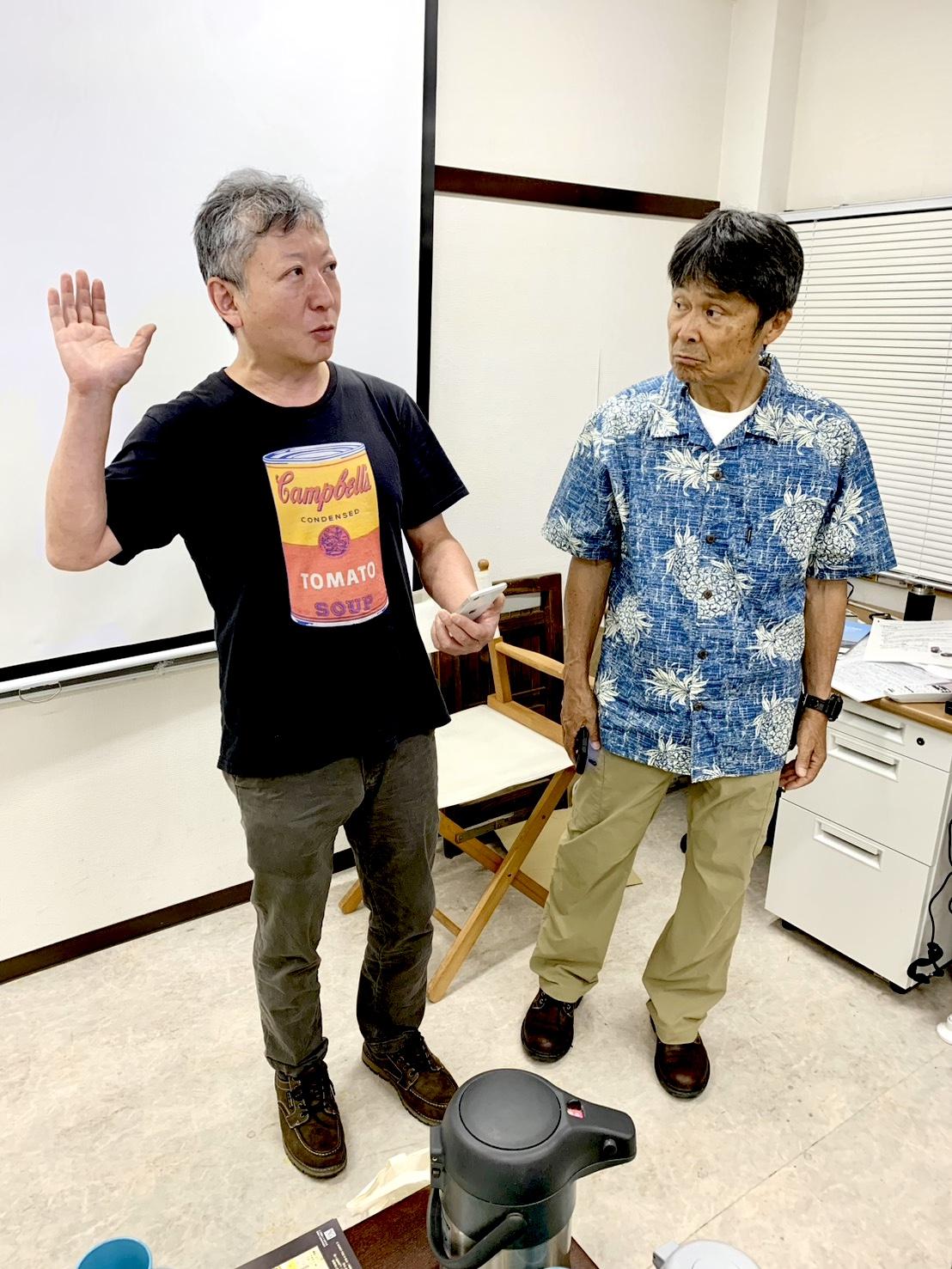
I spoke with Takemoto briefly after the lecture. After briefly introducing my current activities, I posed this question: "I'm focused on helping individuals in Gaza, but I don't see Israel changing through democratic means. Japan, too, could only change by being crushed by force. Or rather, looking at Japan's current rightward shift, it seems Japan ultimately failed to change. Can Israel be changed through nonviolence?" I was somewhat lacking in composure in the presence of my hero. Takemoto listened carefully to my passionate, hesitant words. I continued, "I think you have a consistent perspective on changing the world through nonviolence. Isn't that based on the cooperative philosophy you practice?" Takemoto nodded emphatically. "That's right." The first floor of the venue for today's lecture is "ecostore papalagi," a shop founded by Takemoto. It's a shop that practices ecological philosophy, stocking organically grown vegetables, Palestinian olive oil and soap, and more. Takemoto used to be the owner and president of this shop, but now it has transitioned to a cooperative management system. All the staff are relaxed yet passionate about their work. In short, this is a model of the world Takemoto envisions. Even so, I was so excited that I ended up talking non-stop. The attached photo was taken by my brother at the time. The man on the left in the black T-shirt is me. The person on the right in the aloha shirt is Takemoto. Unfortunately, he doesn't look very happy.
However, after listening to me, he said, "Let's go to Sicily together next year." Whether that will actually happen or not, I'm incredibly happy right now.