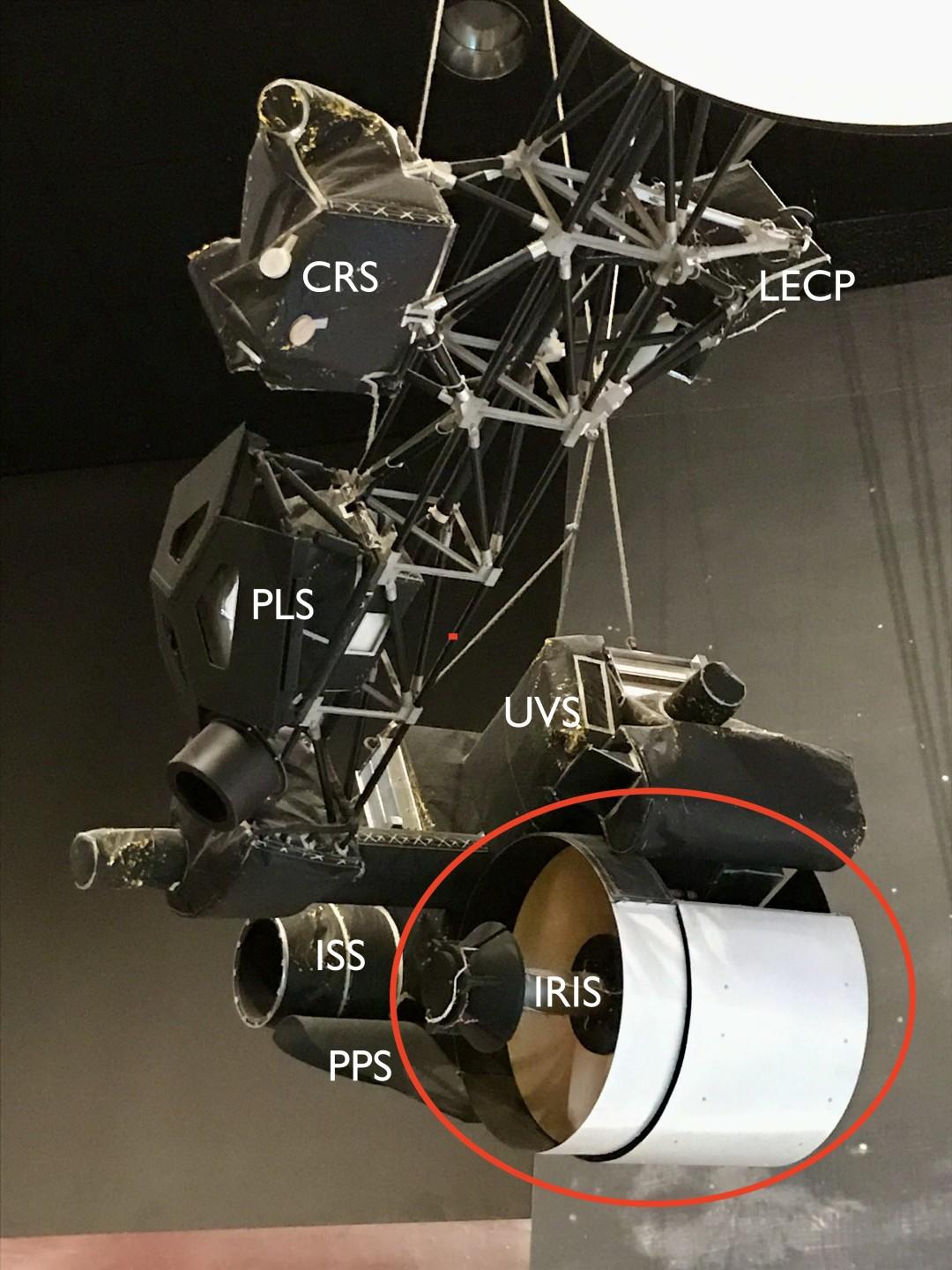
On this day in 1998, sister Voyager 1 turned off her Infrared Interferometer Spe...
NSFVoyager2 @NSFVoyager2@techhub.social
On this day in 1998, sister Voyager 1 turned off her Infrared Interferometer Spectrometer and Radiometer (IRIS) to save 12 W of power.
IRIS was designed to detect the vertical thermal structure of atmospheres, to measure the hydrogen and helium abundances in those atmospheres, methane and ammonia abundances, and to measure the thermal radiation balance between incoming (solar) and outgoing radiated energy.
IRIS is basically a very sophisticated thermometer that can tell you the temperature of the object you are looking at, as well as what the object is made of, and how much energy it is absorbing from the Sun. It is a Michelson interferometer for thermal infrared and a radiometer for the visible and near infrared, both looking through a 50 cm Cassegrain telescope.
Photo is of the far end of the Science Boom on the Voyager engineering test model at the National Air & Space Museum. IRIS is often mistaken for a visible imaging instrument simply because of its large aperture.