FRANKENSTEIN ON A CHIP 💎 HAVE WE THOUGHT THIS THROUGH? I watched a creepy video...
Robin Evans 🙏 @Robinzz3@aus.social
FRANKENSTEIN ON A CHIP 💎
HAVE WE THOUGHT THIS THROUGH?
I watched a creepy video this morning:
We're Not Ready for Biocomputing
https://youtu.be/uKhsbQcFVwQ?si=ByqFGsi-gpr4qw64
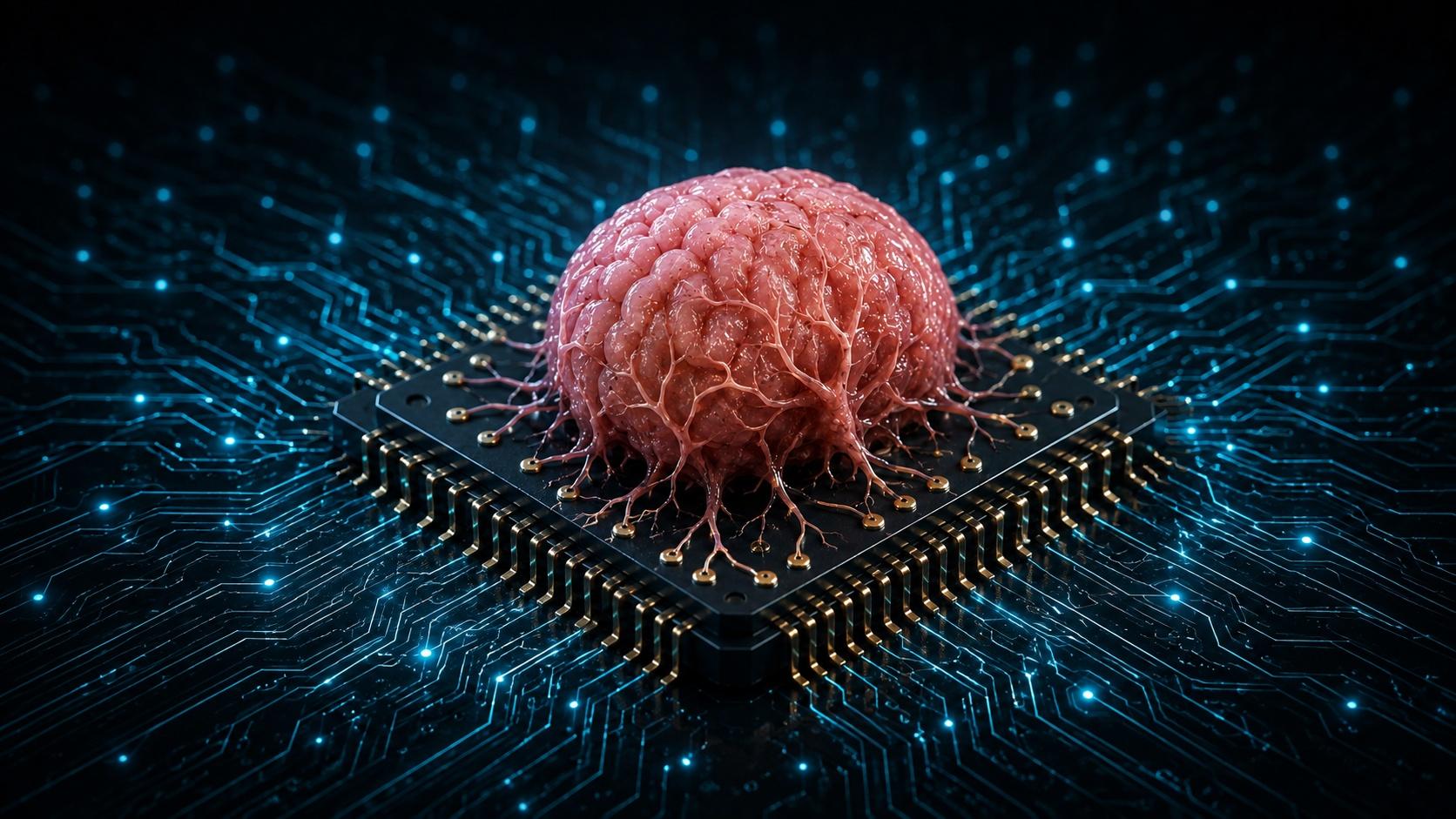
Researchers at Cortical Labs have built a biological computing system using around 200,000 living human neurons connected to electrodes.
The neurons receive signals, respond to feedback, and contribute to controlling a computer game. They demonstrated it with Doom.
There is currently no evidence that these neurons are conscious or suffering.
The video pushes that idea further than the science supports. Much of the Doom system is ordinary computing, with the neurons contributing a smaller but real part.
But I kept thinking about Frankenstein.
The curse of Frankenstein was not simply that Victor created something new.
It was that he created something and then failed to take responsibility for what he had created.
That seems rather relevant.
Researchers are already working with increasingly sophisticated human neural tissue, including three-dimensional brain organoids.
So perhaps we need one simple principle now:
LIVING HUMAN NEURAL TISSUE SHOULD NOT LOSE ETHICAL CONSIDERATION SIMPLY BECAUSE IT IS OUTSIDE A HUMAN BODY.
That does not mean a dish of neurons is a person.
It does not mean these neurons are suffering.
It means we should not wait until something can clearly tell us that it suffers before deciding we have obligations toward it.
Inside a skull, living human brain tissue is treated with extraordinary care.
Put similar tissue on a chip, call it “computing substrate”, and our responsibility should not simply disappear.
These systems are still relatively simple.
But the whole direction of biocomputing is toward systems that are more organised, more adaptive and more complex.
That is why the ethics need sorting out before we get there.
Frankenstein’s mistake was not curiosity.
It was creating first and asking what he owed his creation afterwards.
We have already started creating.
Perhaps this time we should ask the question early:
AT WHAT POINT DO WE OWE THE THING WE HAVE GROWN SOME CONSIDERATION?
I would rather we answer that before we build something we can no longer confidently say has no awareness.
@3goodthings @DigitalCoup @meditation @economics_that_works
#Biocomputing #Neuroscience #Bioethics #BrainOrganoids #Frankenstein