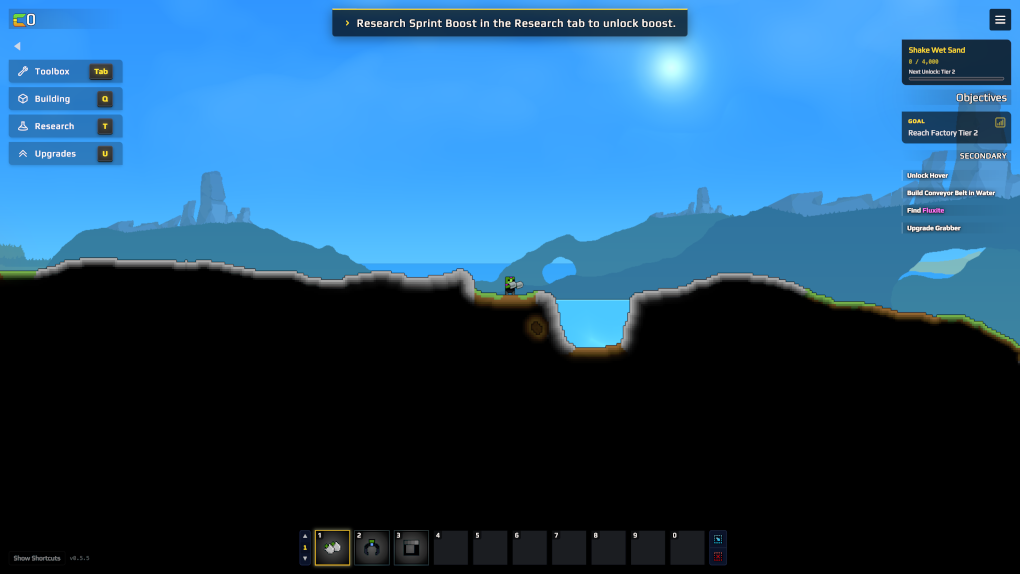
Been mildly bitten by Sandustry. You start as a pixely blob with shovels for han...
Theriac @Theriac@plasmatrap.com
Been mildly bitten by Sandustry.
You start as a pixely blob with shovels for hands (you will continue to be the pixely blob for the rest of the game, but your hands improve). Your immediate objective is to grab a handful of sand, drop it in water then shake it to get goldust.
Without spoiling anything - gold is just the gateway drug, there to teach you the mechanics. Halfway through my first playthrough I was melting the 100k+ gold I had so it would take up less space. That’s right I was irked at how much storage space gold had rather than gloating over how much gold I had.
But lets get some things out of the way:
It’s not Terraria, Factorio or Noita.
Yes it’s 2d and if I’m honest that’s the reason I’ve never played Terraria. It wanted to be Minecraft and I’d moved on.
I’ve also played Factorio, but not having to keep the wiki open at all times was refreshing, back when Tekkit was king docs were king. But things have moved on.
Sandustry has complex systems, but it’s fairly transparent. Don’t get me wrong I’ve played Dwarf Fortress, complexity doesn’t put me off. Once you get the game’s premise that the default unit is the pixel, and almost every material can change state between solid, liquid and gas in a game where you build your own steam engines rather than slapping down a fully formed machine, it’s a heap of fun.
When you hit stuff it turns to pixel dust. What happens after is where Noita and Sandustry diverge. The learning curve requires careful thought and close study of the build item tool info in game not blood, sweat and tears.
Progression is gated behind goals, which unlocks new build parts, and with them new complexities. But there is no Factorio forced sense of urgency, you can advance at your own pace. You aren’t punished for \dropping something in lava, or accidentally venting a gaseous substances. The tech components cost no resources to fabricate and there are well thought out UI tools designed for quality of life.
The clincher for me though was when I designed my own first fully-automatic machine, yet a simple link in a chain to process a single resource. Nought but a stepping stone but internally it used laws of thermo-dynamics. All without looking about on the net for an answer, because by moving from hand-shaken wet sand to using build parts to do the shaking and wetting then automating then scaling up, then teching up further, I’d seamlessly learned how to look at the problems and what systems I had to hand. That’s not to say I didn’t puzzle over how to get the results or that I didn’t have to tweak and troubleshoot my creations but I’ve never felt more accomplishment from designing each part of a production chain, as opposed to Factorio’s grabbing off-the-shelf solutions designed to someone else’s spec.
#gaming #shareYourGames