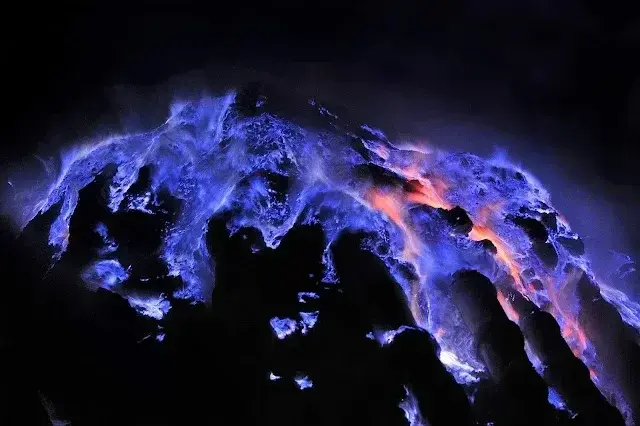
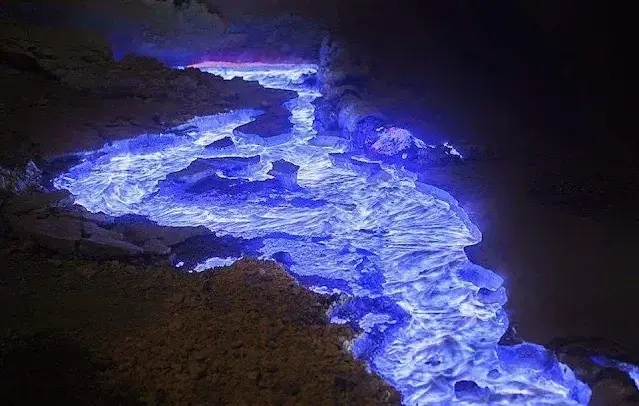
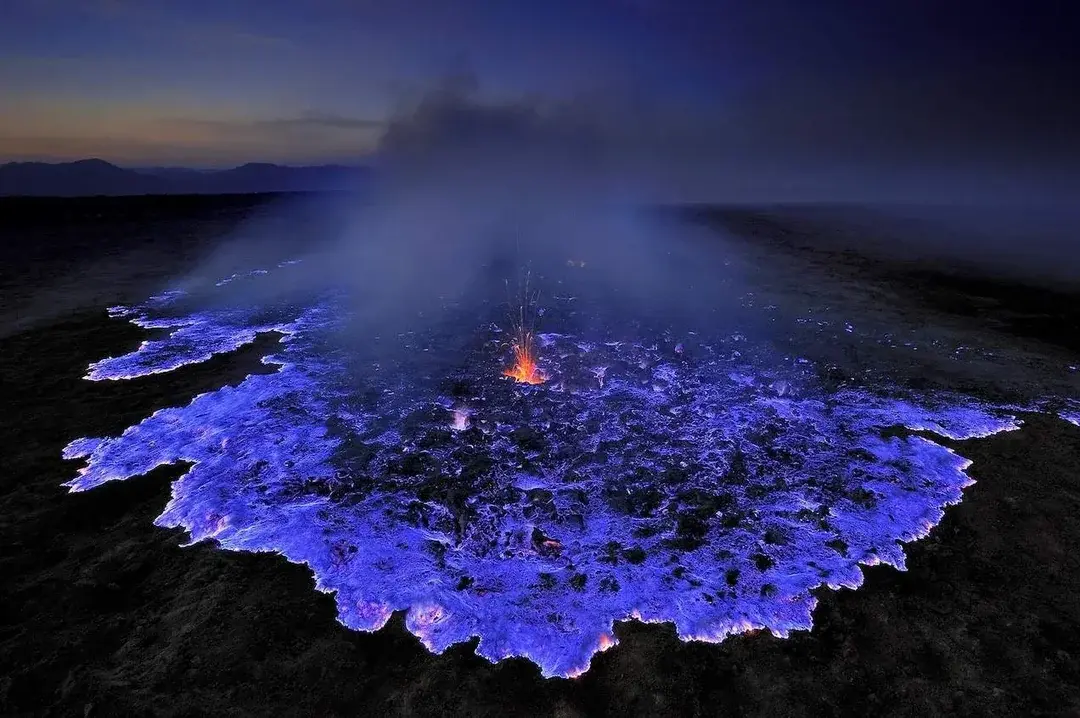
@glasspusher This volcano in Indonesia erupts icy violet colored lava at night. ...
paul @amiserabilist@beige.party
This volcano in Indonesia erupts icy violet colored lava at night. It's real, it's on Earth. (Kawah Ijen, Indonesia).
It's not actually blue lava it's sulfuric gas igniting at 600°C as it hits oxygen.
She spewed blue velvet (Woah-woah)
Bluer than velvet was the night (Woah-woah-woah)
Softer than satin was the light
From the stars
Why does burning sulphur have a blue flame?
I couldn’t find a clear answer to this question. But, here’s my guexplanation…
Sulfur occurs as S8 cyclic molecules (octasulfur) in the solid state, and it is yellow in color. This means that the molecule absorbs light in the near-UV and blue-violet end of the visible spectrum, thereby reflecting yellow color.
Sulfur is readily sublimable at elevated temperatures, meaning that individual S8 molecules can be vaporized easily.
When solid sulfur burns, the individual S8 molecules are thermally excited, and subsequently emits this energy. We already know that S8 molecule absorbs in the blue-violet end of the spectrum. It is therefore likely that the excited S8 molecule will emit visible radiation in the blue-violet end of the visible spectrum. This is why the flame appears blue when sulfur burns.
https://www.quora.com/Why-does-burning-sulphur-have-a-blue-flame
A flame test is a relatively quick test for the presence of some elements in a sample. The technique is archaic and of questionable reliability, but once was a component of qualitative inorganic analysis. The phenomenon is related to pyrotechnics and atomic emission spectroscopy.[1] The color of the flames is understood through the principles of atomic electron transition and photoemission, where varying elements require distinct energy levels (photons) for electron transitions.[2][3]