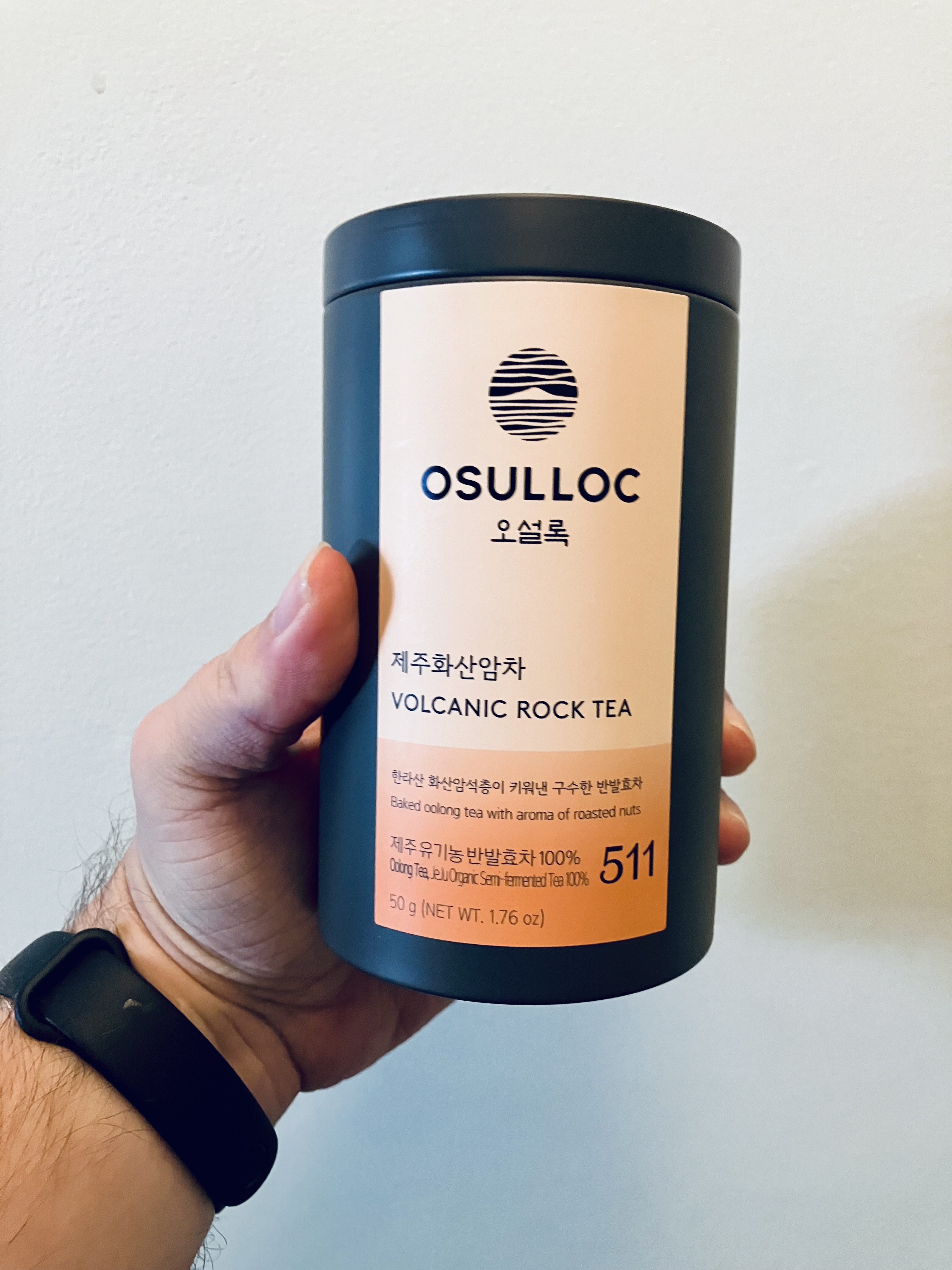
Today’s tea is Volcanic Rock oolong tea, grown and harvested on Hannan farm, Jej...
Chris Trottier @atomicpoet@atomicpoet.org
Today’s tea is Volcanic Rock oolong tea, grown and harvested on Hannan farm, Jeju Island, South Korea. It is sold by OSULLOC, and I bought it this year in Seoul.
Indeed, this is one of the teas I picked up from my recent trip to Seoul. And finding tea was a major reason for my trip. This, right here, was one of the best teas I tasted in South Korea.
South Korea isn’t as known for tea as China, Taiwan, or Japan. However, it has a renowned tea growing region in its south, Jeju Island—which is notable for its volcanic soil. This gives the tea a unque character.
Being an oolong, this is a semi-fermented tea. Not green, not quite black. But to say oolong is about fermentation misses the point.
Oolong is one of the most difficult to make teas in the world. It involves lightly bruising the edges of the leaves in order to bring out character. Which is why oolong is often the most expensive tea in the world.
And of all the oolongs, rock oolongs—those grown either on mountains or rocky soil—are in even higher demand. This particular oolong, growing on volcanic rock, therefore is quite special.
The label says this has tasting notes of roasted notes. This is true. But there’s also something unexplainable that reminds me of volcanic ash.
Also, the label has brewing instructions: put two teaspoons of leaves in a 300mL pot, add water that’s heated to 90°C, steep for two minutes.
I will take this advice for the initial brew because tea merchants often know something about the tea that I don’t.
But afterwards, I will be doing my typical gongfu brew where I put in 5g of leaves into a 120mL teapot, and do an initial steep of 30 seconds, with time increasing for each subsequent steep.
I’m quite excited to be having this today!