Today I finally have time for tea. Not tea swallowed between conversations nor a...
Chris Trottier @atomicpoet@atomicpoet.org
Today I finally have time for tea.
Not tea swallowed between conversations nor abandoned on a table until it becomes a little brown corpse nor made while one half of my brain is already galloping toward the next obligation.
Actual tea.
Five days since I’ve had one properly made, and today I want to sit down and perform the whole strange little ceremony with some intention.
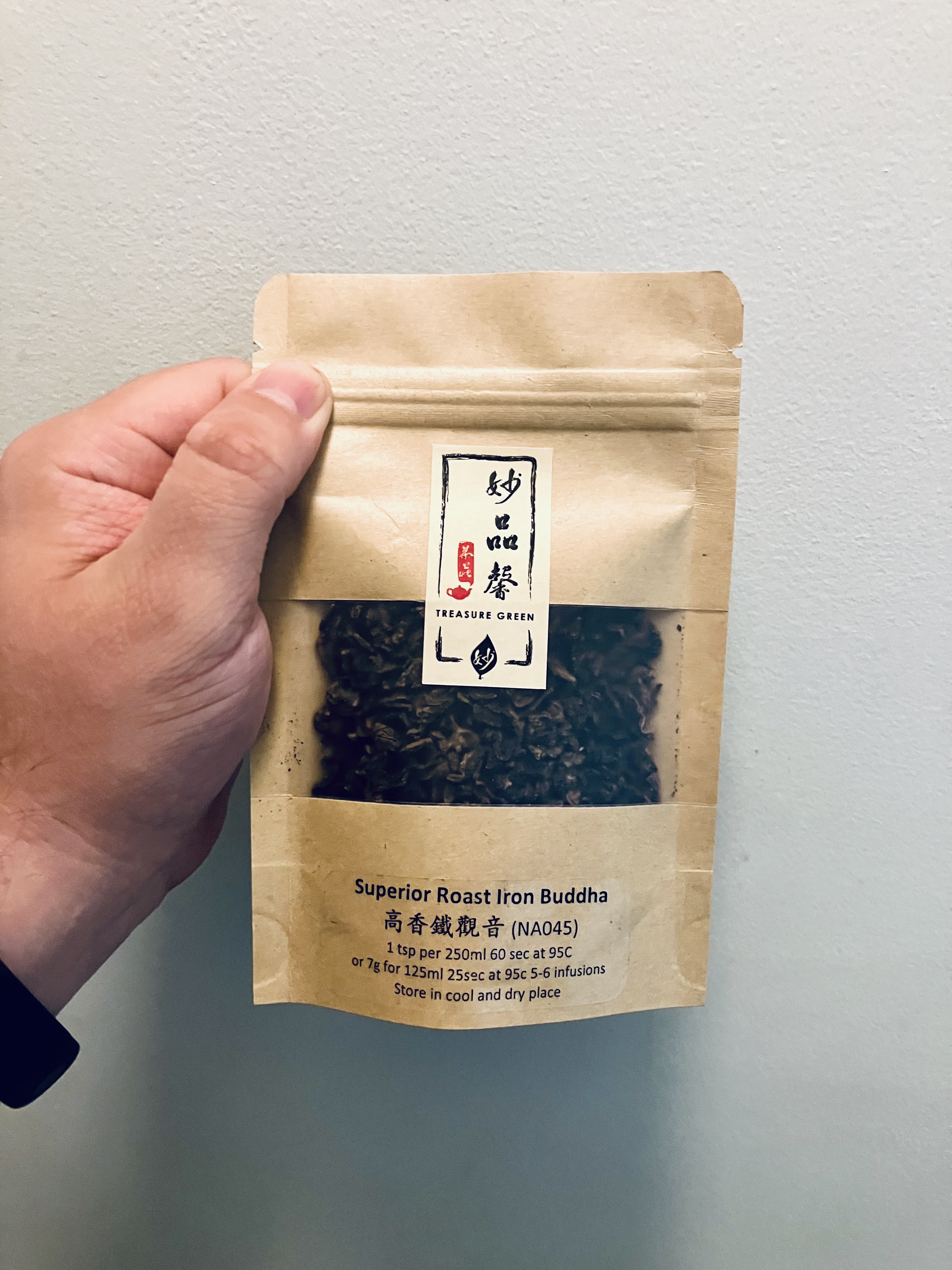
Today’s specimen is Superior Roast Iron Buddha—Gao Xiang Tie Guan Yin—from Anxi County in Fujian, sold by Treasure Green.
I already have another Tie Guan Yin, but this one has been through the fire.
And I mean that almost literally.
Tie Guan Yin is more than 300 years old, one of the great names in Chinese tea, named for Guanyin, the Bodhisattva of Compassion—the Goddess of Mercy. Not Siddhartha Gautama. Different Buddha business entirely.
Naturally, a tea this old has collected ghosts.
One story has an old farmer named Wei tending a neglected temple containing an iron statue of Guanyin. Nobody else could be bothered, apparently, but Wei kept sweeping the joint and making offerings. Then one night Guanyin crawled into his dreams and pointed him toward a cave.
Inside: a tea shoot.
He planted it. It grew. He propagated it. He gave cuttings to his neighbours.
Tie Guan Yin.
Iron Goddess of Mercy.
That’s one story.
Another has a scholar named Wang finding the plant beneath Guanyin Rock during the reign of the Qianlong Emperor. Wang cultivated it and eventually presented the tea to the Emperor, who supposedly gave it the name for its iron character and its association with Guanyin.
Either way, somewhere in the story there’s an iron goddess lurking around a mountain and somebody comes home with tea.
Good enough for me.
And the mountain really does matter here—it’s no small thing.
Inner Anxi gets elevation and cold winters severe enough to put the tea bushes to sleep. They sit there dormant until spring, quietly accumulating the chemistry that will eventually end up in my cup: polyphenols and other compounds transformed through oxidation, roasting, water and time into something my tongue interprets as flowers, fruit, nuts, honey.
Chemicals activated, subtle flavours, resurrected at 95°C.
Modern Tie Guan Yin is often much greener. Lightly roasted. Sometimes essentially unroasted. Bright, floral, perfumed stuff.
This one comes from the older school.
Fire.
A traditional 50-percent heavy roast, conducted in rounds over weeks, with resting periods between roastings so the leaves can settle down and contemplate what has been done to them.
The result is sitting in front of me now.
Little hard pellets of curled leaf. Dense. Dark brown, reddish brown, some nearly black. They look less like flowers than ammunition for an extremely small war.
And for once, I’m in no hurry to shoot them.
That’s the important part today.
I have time.
I can heat the water deliberately. Weigh the leaves. Warm the vessel. Smell the dry leaf before water touches it. Listen to the pour. Watch those little roasted fists slowly unclench.
Treasure Green recommends 95°C either way: one teaspoon in 250 mL for 60 seconds Western-style, or 7 grams in 125 mL for 25 seconds gongfu.
I’m thinking gongfu.
Not because I need seven microscopic cups of tea to turn into a spiritual revelation
It’s smaller than that. It’s because—at least for today—I can actually pay attention.
25 seconds.
Pour.
Smell.
Drink.
Then do it again and see what crawls out of the leaves next.
The roast should come first: deep, full-bodied, nutty. Then fruit. Then that orchid character Tie Guan Yin is famous for, somehow surviving underneath all that fire. And finally the huigan—that returning sweetness, the honeyed little ghost that hangs around in the throat after the tea itself has gone down.
That’s what I’ve missed these past five days.
It’s not about the caffeine, nor about merely drinking something hot.
It’s this.
Making one thing carefully because, for once, nothing is standing behind me tapping its watch.
The Iron Goddess has waited 300 years.
She can have my afternoon.