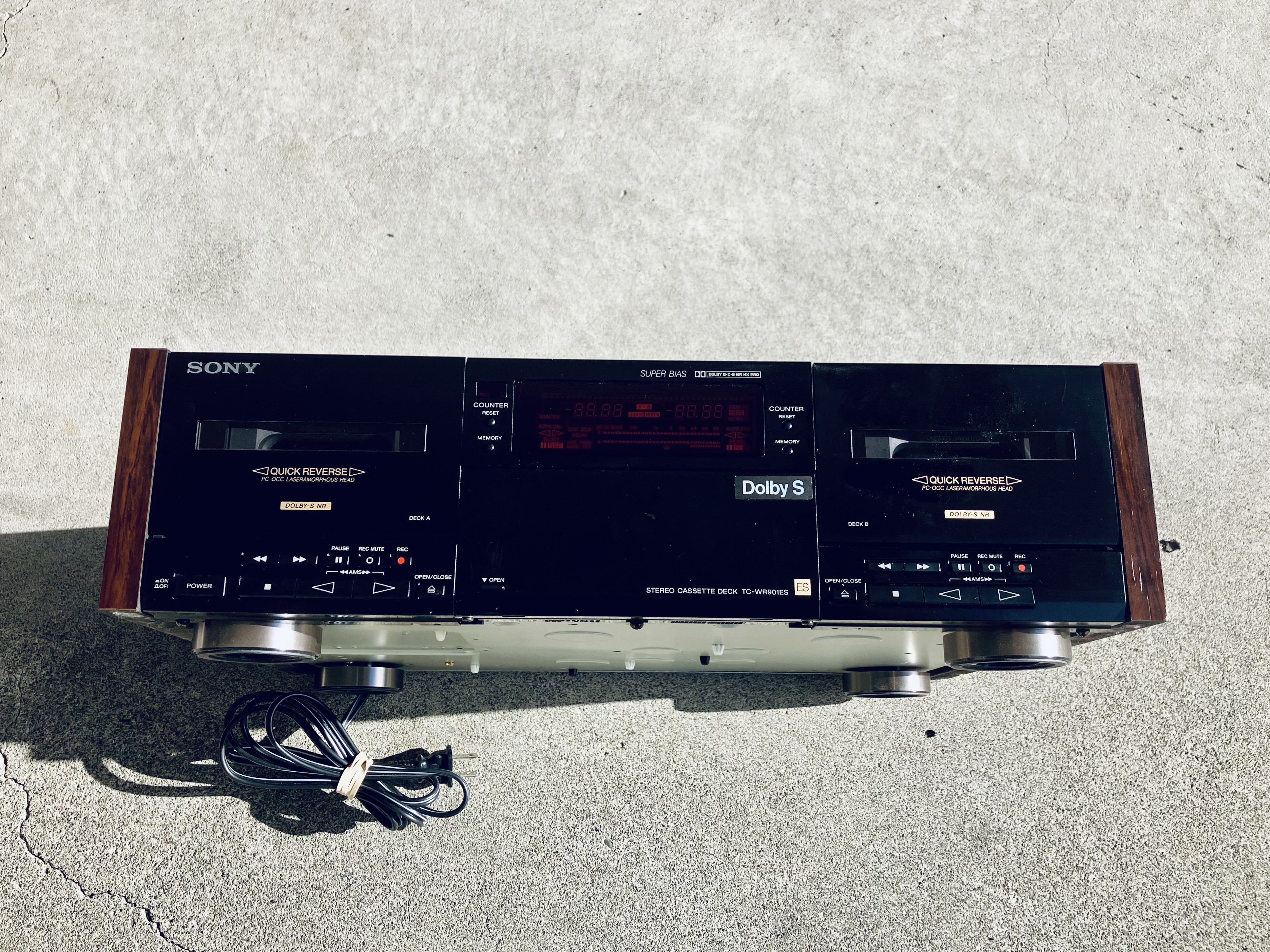
Just bought something truly stunning. But first, a question: What if everything ...
Chris Trottier @atomicpoet@atomicpoet.org
Just bought something truly stunning.
But first, a question:
What if everything you knew about cassettes was wrong?
Listen to the armchair audiophile long enough and he’ll tell you tape is garbage. Hiss. Mud. Cheap plastic crap your dad kept rattling around under the passenger seat.
Vinyl, meanwhile, is holy.
Baby, no.
By the late ’80s, cassette technology had become a beautiful little monster. And sitting in front of me is one of its last great mutations: the Sony TC-WR901ES, released in 1993.
Inside this black slab is Dolby S.
This was Dolby’s final noise-reduction system for analog tape. B came first. Then C. Then S arrived at the funeral wearing a leather jacket.
With the right deck and tape—especially metal—Dolby S pushes this deck to an 83 dB signal-to-noise ratio. No hiss. Analog sound that could absolutely make vinyl sweat.
Near-CD quality.
From a cassette.
So why doesn’t everybody remember this?
Because Dolby S showed up while CD was already eating tape alive.
CD didn’t need rewinding. Didn’t need flipping. Didn’t get chewed into magnetic spaghetti. You could play an entire album uninterrupted and jump straight to track seven without sitting there holding FAST FORWARD like some laboratory ape waiting for a pellet.
And recording?
Sony had DAT.
Digital Audio Tape.
Another little black coffin, except this one had digits inside.
There were even prerecorded Dolby S cassettes. Not many. Beautiful things. Engineering pushed almost obscenely far for a format already being marched toward the grave.
That’s what I love about this deck.
It comes from that delicious moment when the corpse hadn’t been informed it was dead yet.
And this particular corpse?
Around $1,200 on eBay.
I paid $40.
It’s unserviced. Needs a little work.
Fine by me.
Forty bucks for a dead format’s last dirty trick.