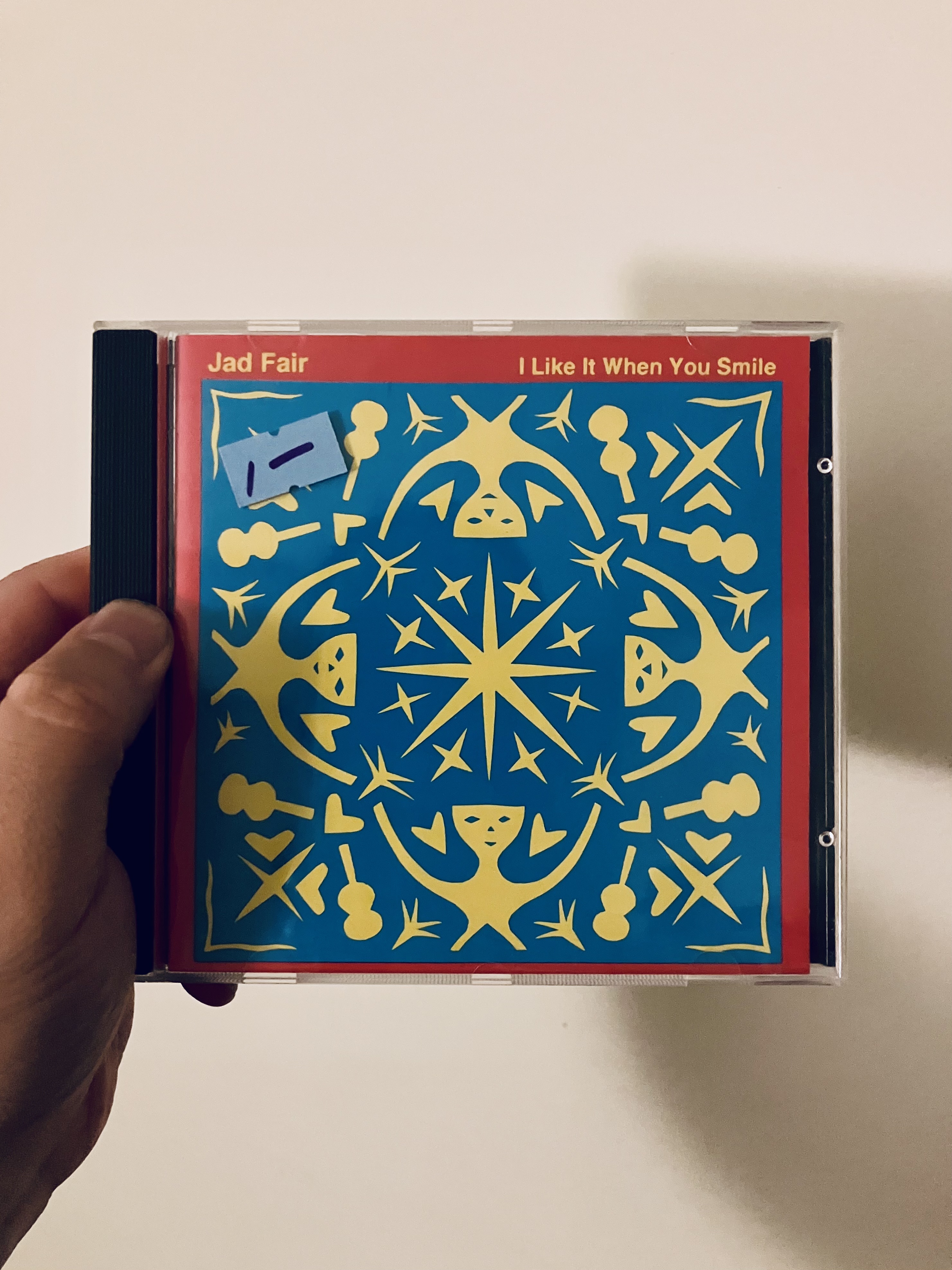
Jad Fair first crawled onto my radar through Daniel Johnston. This was back in t...
Chris Trottier @atomicpoet@atomicpoet.org
Jad Fair first crawled onto my radar through Daniel Johnston.
This was back in the 2000s, when Virgin Megastore still existed. I walked past a display, saw their album It’s Spooky, went, “Huh,” and stuffed the name into that filthy Rolodex in my head where useless music facts go to breed.
Later I looked him up and found his band Half Japanese.
Jad Faie is obscure, yes, but also nfluential as hell. But mostly influential among musicians, because I almost never hear regular music fans talk about Jad Fair.
Not even hipsters.
And hipsters will name-drop a bass player who appeared on 3 copies of a Belgian post-punk single in 1981.
Then last week I was crawling through a local thrift store and found a Jad Fair album for $1. So I bought it.
I got it home, looked at the credits, and found a little army of heavy hitters:
* J. Mascis
* Steve Shelley
* Ira Kaplan
* Terry Adams
* Don Fleming
If those names mean nothing to you, spend 5 minutes on Wikipedia. There’s a lot of musical blood running through that list.
I have no idea how Jad Fair keeps attracting people like this.
Maybe musicians just like the guy.
The album itself sounds strangely ahead of its time. There’s plenty of alternative rock and grunge stink on it, which makes sense for 1992. But the thing that really jumps out is the lo-fi production.
A decade later, that rough homemade sound would be all over indie music. Yet in the early 90s, Jad Fair was already rolling around in it.
His voice helps too. There’s a schleppy, crooked quality that reminds me a little of Daniel Johnston, except Fair sounds more deliberate. Like he knows exactly how strange he sounds and has no interest in sanding off the edges.
That may be why he never went mainstream.
He isn’t “edgy” in the usual sense. He doesn’t sound like somebody trying to shock anybody. He just sounds like somebody who never noticed there was a box he was supposed to climb into.
Which may also explain why so many musicians keep wanting to work with him.