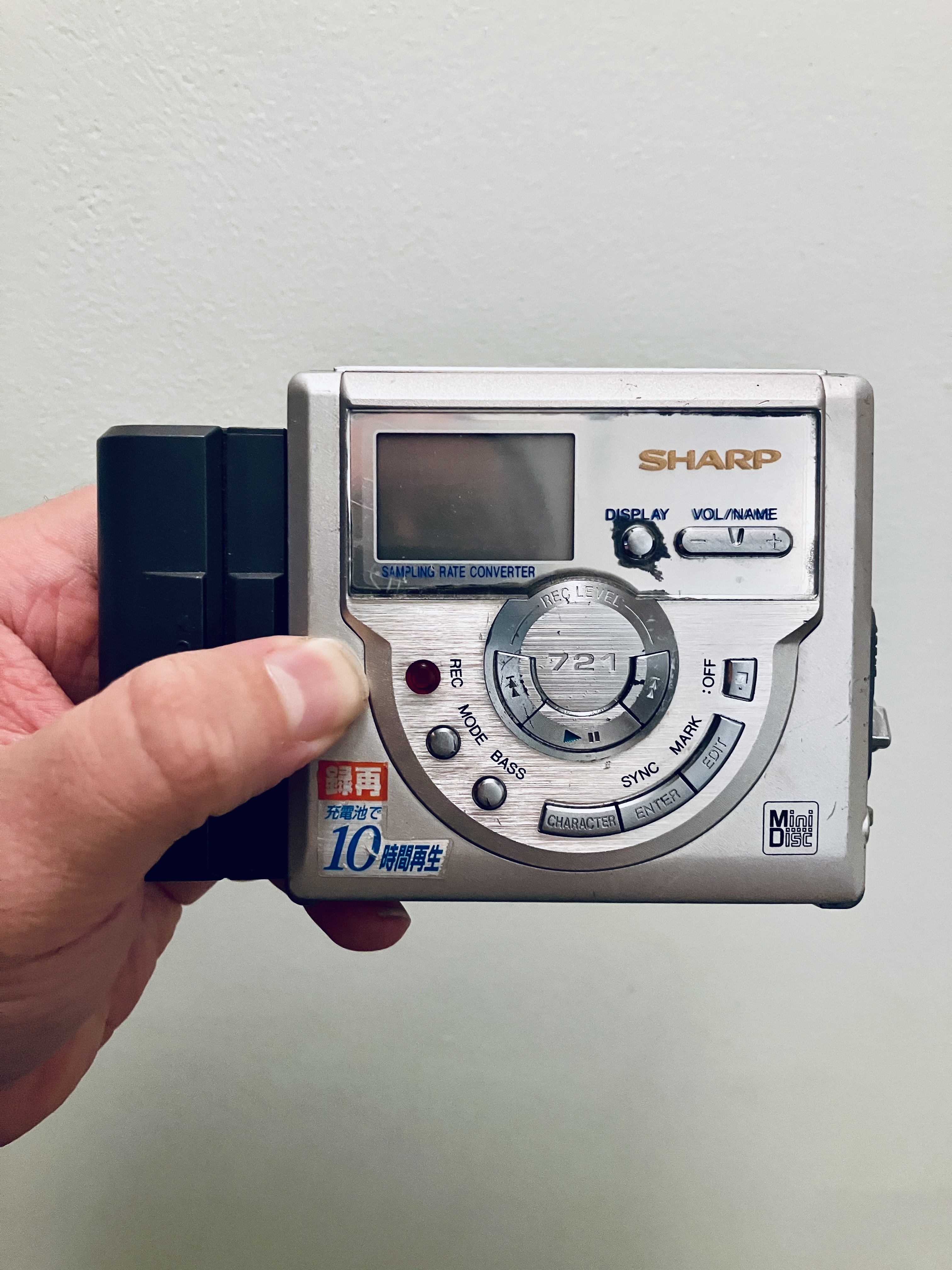
For the past few days, I’ve been messing around with a MiniDisc player I found a...
Chris Trottier @atomicpoet@atomicpoet.org
For the past few days, I’ve been messing around with a MiniDisc player I found at a flea market.
It’s a Sharp MD-MS721, introduced in 1998.
For YEARS, people have asked me, “Why don’t you get a MiniDisc player?”
My answer was always the same: MiniDisc was never that big in Canada, so what were the odds I’d actually find one in the wild?
Well, I finally did.
And after listening to a couple MiniDiscs and recording a couple myself, I get it now.
The appeal isn’t that MiniDisc is some tiny CD.
It’s more like a digital cassette.
You can RECORD on the damn thing.
Now, digital cassettes already existed. There were 2 formats, in fact: DAT and DCC. DAT failed because the music industry was scared of piracy. And DCC failed because the format didn’t offer many creature comforts.
MiniDisc actually succeeded. Not in North America, but it got huge in East Asia and parts of Europe.
And a big reason is that, unlike DCC, MiniDisc had the creature comforts.
Instant track access. Easy editing. Track naming.
You can delete tracks, reorder them, combine them, or wipe the whole disc clean.
The part I especially love is being able to adjust the input level. If the source is too loud, you just knock it down.
It’s so simple
But there’s a catch.
Unlike CD, MiniDisc is lossy.
It uses ATRAC, Sony’s own compression system, something roughly comparable to MP3. My Sharp MD-MS721 can deliver ATRAC at roughly the same quality as a 256 kbps MP3, which is actually better than the bitrate used by plenty of streaming services.
Still, lossy is lossy.
And if I sit down and listen hard, I can hear the scars.
Cymbals get swishy. Piano attacks smear.
Most people probably won’t notice any of that, especially while walking around or driving.
Now, I’m a cassette enthusiast. Cassette is my favourite format.
And MiniDisc beats cassette in some pretty important ways.
Metadata and track selection are the big ones. MiniDisc also has no hiss, better dynamic range, and usually better frequency response.
But MiniDiscs are expensive.
One blank disc on Amazon can cost $33.
Meanwhile, unopened Type II Chrome cassettes can still be had for $20.
And MiniDisc also lacks something cassette has in spades: colour.
Here’s the easiest way I can explain it.
MiniDisc is like a standalone digital camera.
Digital cameras from the 2000s were pretty accurate and pretty consistent. They weren’t great in low light, and they relied on lossy JPEG, but they were compact, easy to use, and dependable.
Cassette is more like a film camera.
An old Kodak film camera can vary all over the place. Accuracy changes. Results change. Everything gets finicky. You can’t preview the picture. You don’t even know exactly what you got until the film comes back.
Film is the opposite of convenience.
But there’s joy in the way the camera, the film, the ISO, and the lighting all mess with the final image.
Same deal with cassette. It’s the so-called flaws that make the thing SING.
That’s why MiniDisc doesn’t replace cassette for me. They’re different beasts, even if they do some of the same jobs.
If I want consistency and precision, I’d rather record to MiniDisc.
If I’m willing to throw a little of it to chance? Cassette all the way.
That said, MiniDisc is definitely a great format.
Now I understand what all the fuss was about.