I’m sorry—we are not in a stock market bubble. I’ve looked into the current P/E ...
Chris Trottier @atomicpoet@atomicpoet.org
I’m sorry—we are not in a stock market bubble.
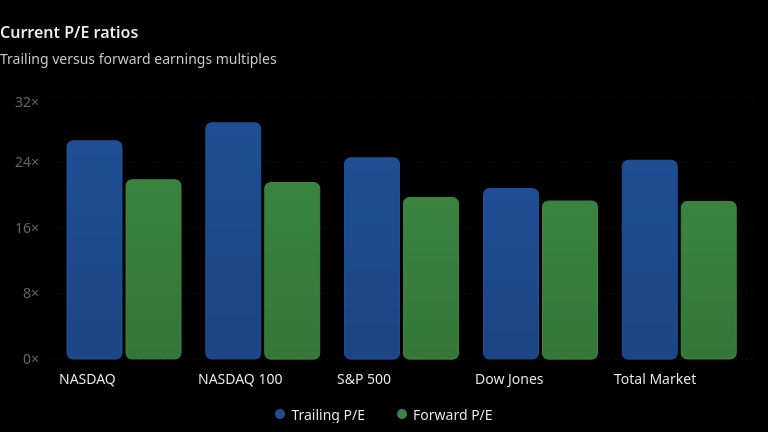
I’ve looked into the current P/E ratio across different indices, and these are the results:
NASDAQ Composite (ONEQ)
- Trailing P/E: 26.66×
- Forward P/E: 21.88×
NASDAQ 100 (QQQ)
- Trailing P/E: 28.84×
- Forward P/E: 21.57×
S&P 500 (SPY)
- Trailing P/E: 24.59×
- Forward P/E: 19.74×
Dow Jones (DIA)
- Trailing P/E: 20.81×
- Forward P/E: 19.31×
Total US Market (VTI)
- Trailing P/E: 24.29×
- Forward P/E: 19.23×
And I’ve looked into PEG, which factors in projected growth:
NASDAQ Composite
- Implied earnings growth: 21.8%
- PEG proxy: 1.00
NASDAQ 100
- Implied earnings growth: 33.7%
- PEG proxy: 0.64
S&P 500
- Implied earnings growth: 24.6%
- PEG proxy: 0.80
Dow Jones
- Implied earnings growth: 7.8%
- PEG proxy: 2.49
Total US Market
- Implied earnings growth: 26.3%
- PEG proxy: 0.73
The conventional wisdom that technology stocks are expensive while traditional blue-chip stocks are comparatively cheap isn’t supported by these particular growth-adjusted figures.
In fact, the NASDAQ 100 appears cheaper relative to implied earnings growth than the Dow Jones, despite trading at a higher P/E.
The central question is whether the projected earnings growth actually materializes. If it does, the NASDAQ 100 looks very attractive. If it doesn’t, its higher valuation creates greater potential downside.
The available statistics DO NOT SUPPORT describing the broad US technology sector as a speculative bubble comparable to 2000. Nasdaq’s historical research estimates the NASDAQ 100’s P/E was approximately 104 at the end of 1999. It was still 113 at the end of 2000, after a major market decline. In comparison, the NASDAQ is trading at 26.66 backward P/E right now.
Taking a look at current trends, the technology sector is trading roughly 15% below its own 10-year average forward P/E, rather than at an unusually high premium.
I therefore reject the claim that technology stocks are currently in a dot-com-style bubble.