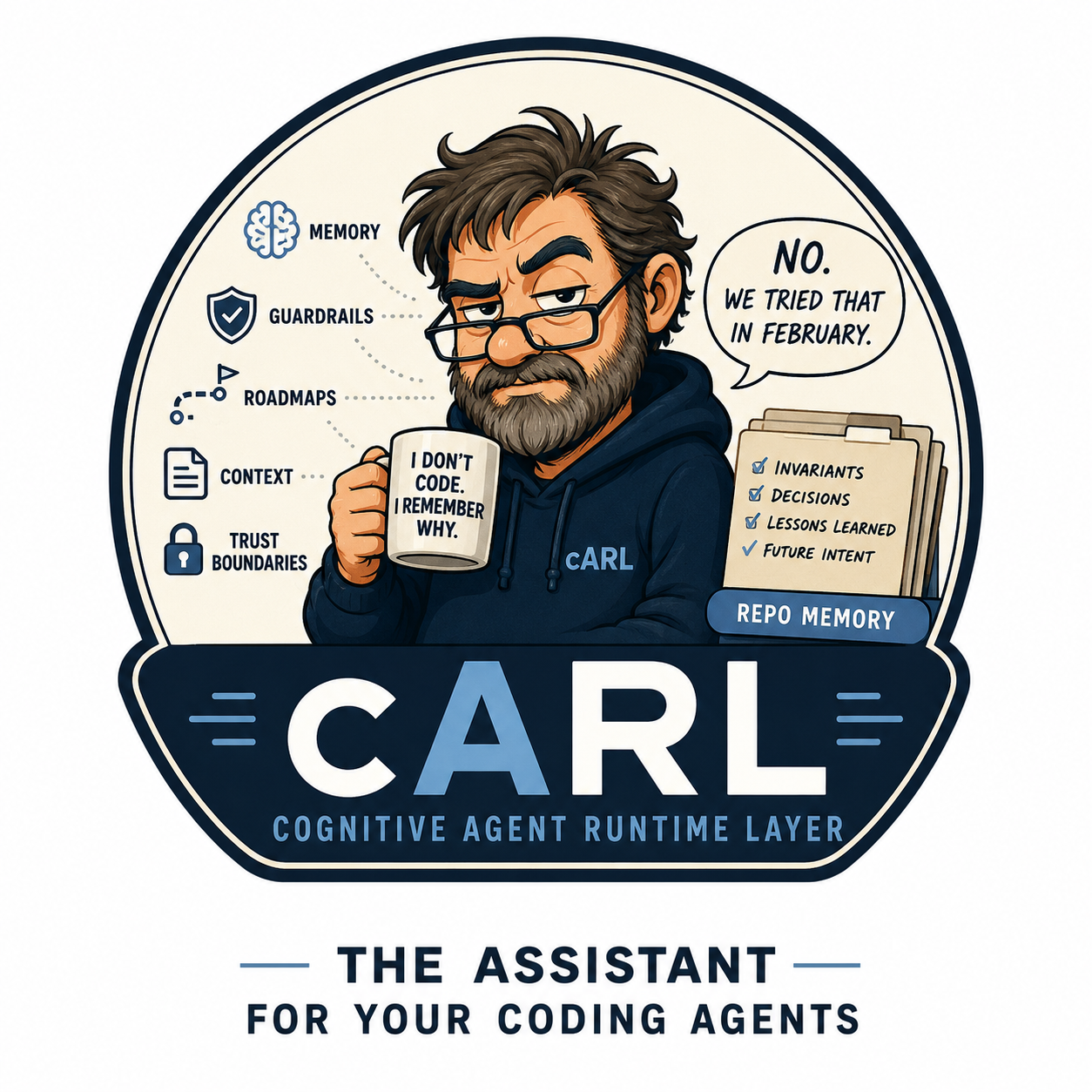
I just field-tested cARL v0.3.0 in GitHub Copilot with Claude Haiku 4.5. The pro...
G :donor: :Tick: @cirriustech@infosec.exchange
I just field-tested cARL v0.3.0 in GitHub Copilot with Claude Haiku 4.5.
The prompt was deliberately vague:
“What’s the rules for working in this repo?”
No steering.
No “read cARL first.”
No carefully engineered prompt.
No lovingly hand-crafted wall of context.
Haiku cloned the repo, found the cARL artefacts, read the right governance surfaces, and produced a solid operating model:
• cARL artefacts are canonical
• harness files are adapters/loaders, not authorities
• repo state beats stale memory
• work should follow hydrate → execute → validate → reconcile → report
• tool permissions are tiered
• final responses need a cARL/docs update decision
Cost: 11 credits.
The cARL hydration tax was $0.11.
Before v0.3.0, the cheapest models needed to be explicitly told to do that. Mid and premium tier models were better at inferring it, but the same kind of prompt cost closer to $0.40–$0.55.
That matters because the alternative is ugly.
Without durable repo-native governance, every new agent session tends to start with one of two bad patterns.
Either it reads half the repository before doing anything, burning tokens and time just to rediscover the same context as yesterday.
Or it charges straight in, makes plausible-looking changes, misses the actual operating rules, and you spend the next several prompts course-correcting it back toward what you meant in the first place.
Often both.
That prompt ping-pong is not free.
It costs credits.
It costs time.
It costs attention.
And worse, it creates the illusion of progress while quietly accumulating drift.
cARL is my attempt to move that context out of fragile chat history and into the repository itself.
The repo should tell the agent:
• what matters;
• what not to touch;
• which artefacts are authoritative;
• how tools may be used;
• when to stop;
• what “done” means;
• and when durable docs/governance need updating.
I don’t want every task to begin with an archaeological dig through the codebase.
And I don’t want to repeatedly explain the same rules to an amnesiac coding agent with a confident typing speed.
For this test, a cheap model discovered the governance model from a normal human question for eleven cents.
That feels like the right kind of overhead.
Tiny grumpy senior engineer in your repo is not taking the agent’s nonsense anymore.