Tiny but important agentic coding lesson from today via, once again, cARL. I had...
G :donor: :Tick: @cirriustech@infosec.exchange
Tiny but important agentic coding lesson from today via, once again, cARL.
I had a pull request waiting for review in a private repo for WhereMyMVPsAt, submitted by a new contributor.
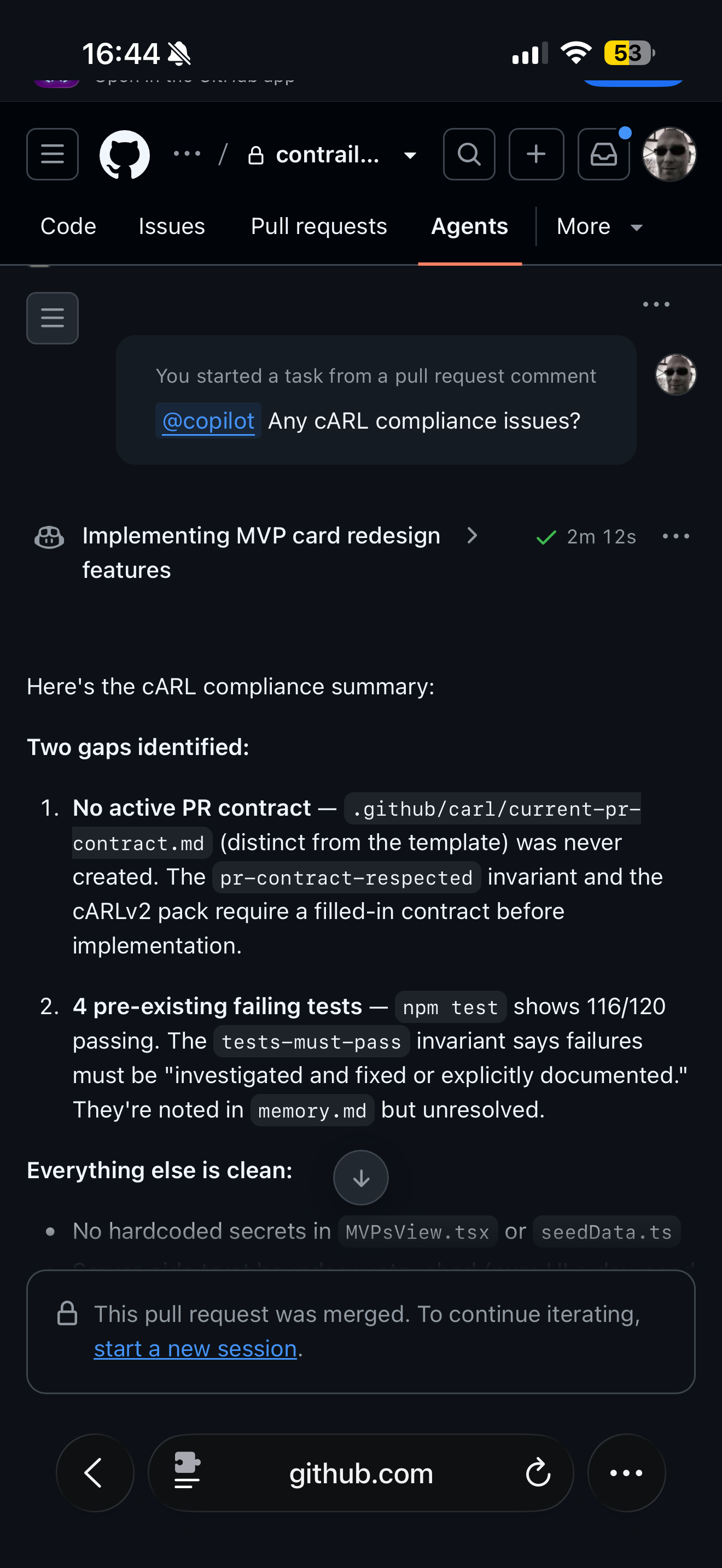
Rather than just reviewing the diff manually, I asked GitHub Copilot:
“Any cARL compliance issues?”
The PR itself was clean from a code/security perspective:
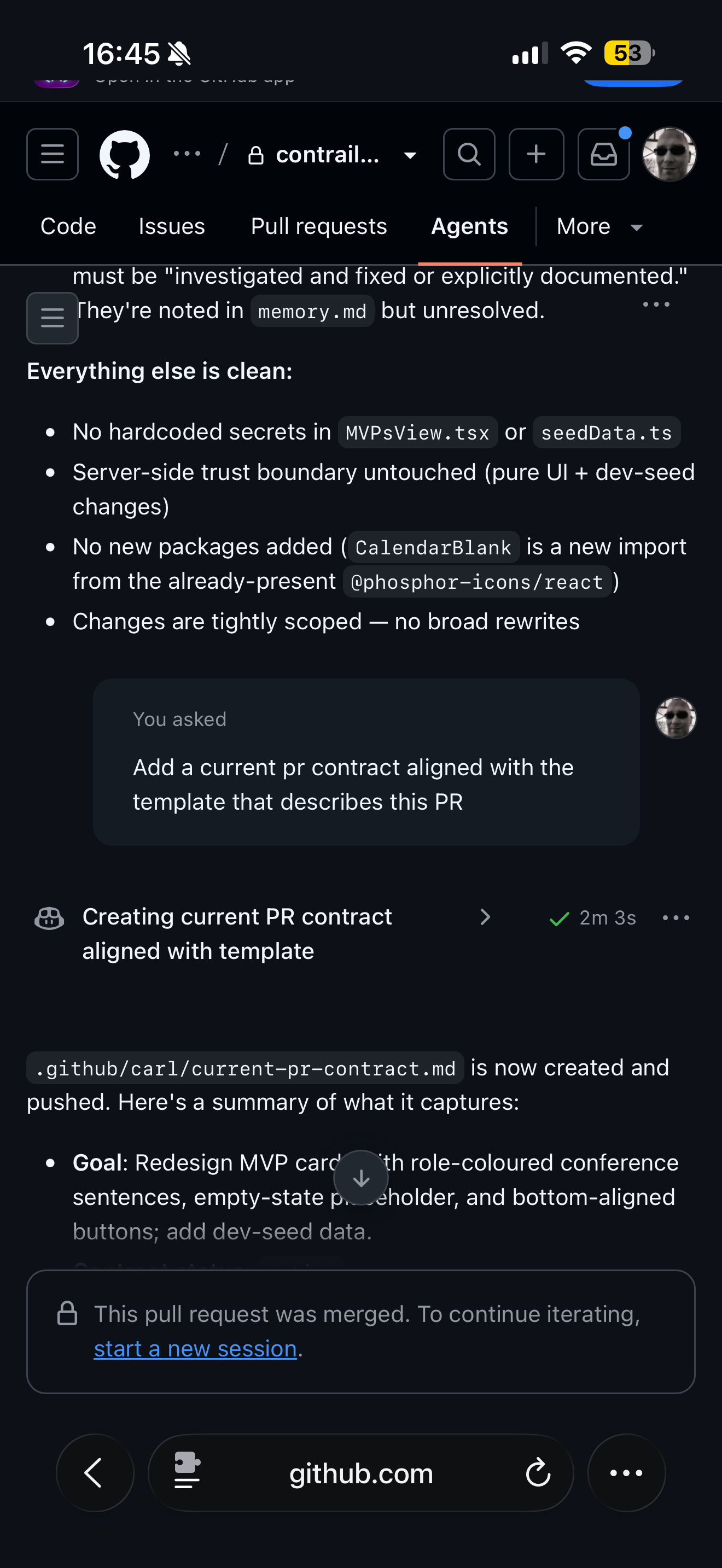
No hardcoded secrets. No server-side trust boundary changes. No new npm packages. No broad rewrites. Pure UI and dev-seed changes.
But Copilot, adhering to cARL, still found two governance gaps.
First, there was no active PR contract.
The template existed, but .github/carl/current-pr-contract.md had not been created for this PR.
That matters because cARL treats the contract as the local operating agreement for the work: goal, approved scope, forbidden scope, security constraints, validation, stop conditions, and reset notes.
Second, there were four pre-existing failing tests.
They were not introduced by the contributor’s PR, but they still mattered. The invariant is not “ignore old failures because this PR did not cause them.” It is “investigate and fix them, or explicitly document them.”
So I asked Copilot, again bound by cARL, to create the current PR contract aligned with the template.
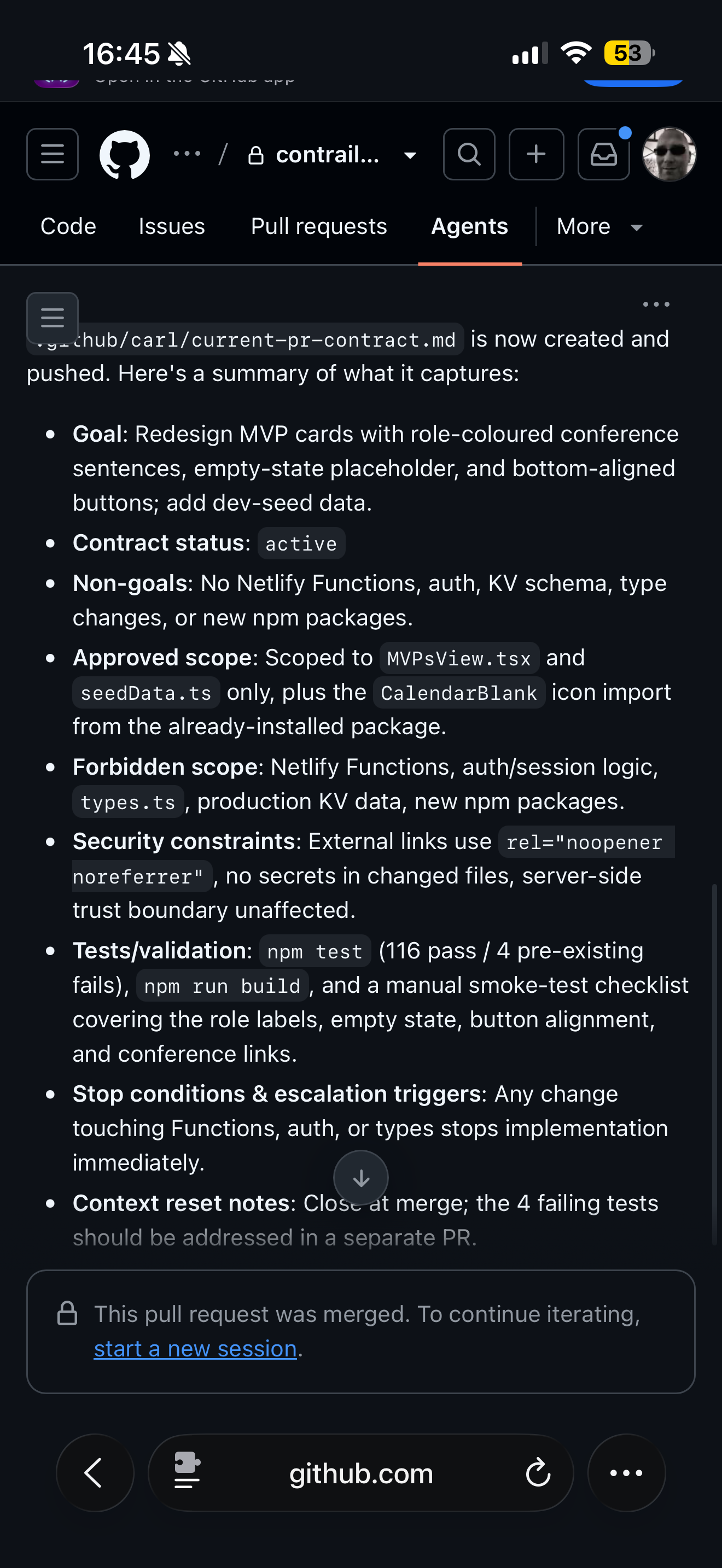
It did, and captured:
• the goal of the MVP card redesign
• the approved files and imports
• the forbidden scope
• the security constraints
• the validation performed
• the known test state
• the stop conditions
• the reset notes for the next session
The useful review outcome was not “this code is bad.” The code was fine.
The useful outcome was: “this work is missing its durable governance context.”
That’s a different kind of review.
It turns agentic coding from a one-off prompt interaction into something closer to an engineering control surface.
For contributor PRs, especially in small private projects, this feels valuable. Not because every change needs heavy process, but because lightweight repo-native governance gives both the human reviewer and the coding agent something concrete to reason from.
It also means it does not matter whether the coder is agentic or human. The compliance review is the same.
The repo carries the intent.
The agent can inspect it.
The reviewer can challenge it.
The next session can inherit it.
Context windows scale vertically.
Repository memory scales horizontally.
Tiny senior security engineer in your repo continues to impress.