The methodology used in this study to provide an econometric perspective over th...
Fabio Manganiello @fabio@manganiello.tech
The methodology used in this study to provide an econometric perspective over the collapse of civilizations is fascinating.
This study considers a simple but surpisingly effective metric to estimate trade in ancient times: the number of coins from a certain place that archaeologists found in another place.
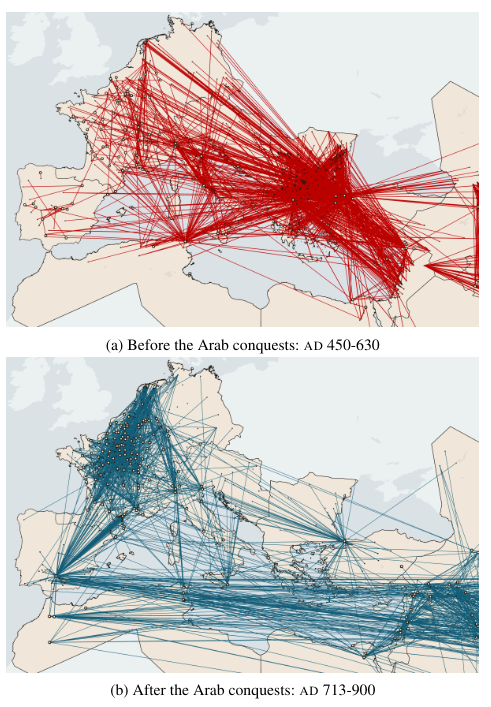
It then applies this proxy metric to analyze trade over Europe in the early Middle Ages, separating them in two distinct phases - before and after the Arab conquest.
Before the Arab conquest (AD 450-630), trade networks were firmly centered on Costantinople and other major cities in the Eastern Roman Empire, but coins from Costantinople have been found all the way in the Middle East, Carthage, Italy, France and the Germanic lands.
Other trade centers (Split, Milan, Ravenna, Lyon, Tyre, Gaza, Carthage) were also very active.
The picture after the Arab conquest (AD 713-900) is dramatically different.
Costantinople remained a trade center, but orders of magnitude smaller, with trade routes that became much more local within the Byzantine territories.
Trade across Europe split into two different axes. One centered over the Middle East, with branches reaching out mostly to North Africa and Southern Spain, and another axis centered over the Frankish world - modern-day France, Belgium and Netherlands.
Foreign trade over the rest of Europe nearly disappeared, and coins circulation also greatly dropped as a consequence.
This kind of studies (similar econometric studies have also been proposed to analyze the collapse of the Late Bronze Age) provide a very valuable insight when it comes to civilizations and their collapse.
A civilization flourishes when trade networks centered around that civilization flourish - and those trade networks are usually mutually beneficial.
A civilization collapses when global trade network are replaced by localized trade - when that happens, supply of goods and coins drops, wages and purchasing power drop, and negative demand/supply feedback loops are triggered that seem to deterministically lead to long-lasting dark ages.