There was a viral joke recently about the 3 largest cities in Germany all lying ...
Greg Egan @gregeganSF@mathstodon.xyz
There was a viral joke recently about the 3 largest cities in Germany all lying on a circle … but whether that made you laugh or groan, it gives me an excuse to mention 3 non-trivial things about the circle through 3 points on 3 kinds of surface.
[1] If you pick 3 points at random on a unit sphere, what is the average radius (measured along the surface) of the circle they define?
If we integrate from r=0 to π/2:
Mean(r) = ∫ r sin³r dr / ∫ sin³r dr
= 7/6
[2] What happens on a flat surface? Here, there is no upper bound on the radius, and it turns out that it grows so high for nearly-colinear points that the average becomes infinite.
[3] For a region in the hyperbolic plane, there is a further twist: sometimes 3 points *don't* lie on any circle, but a different curve known as a hypercycle.
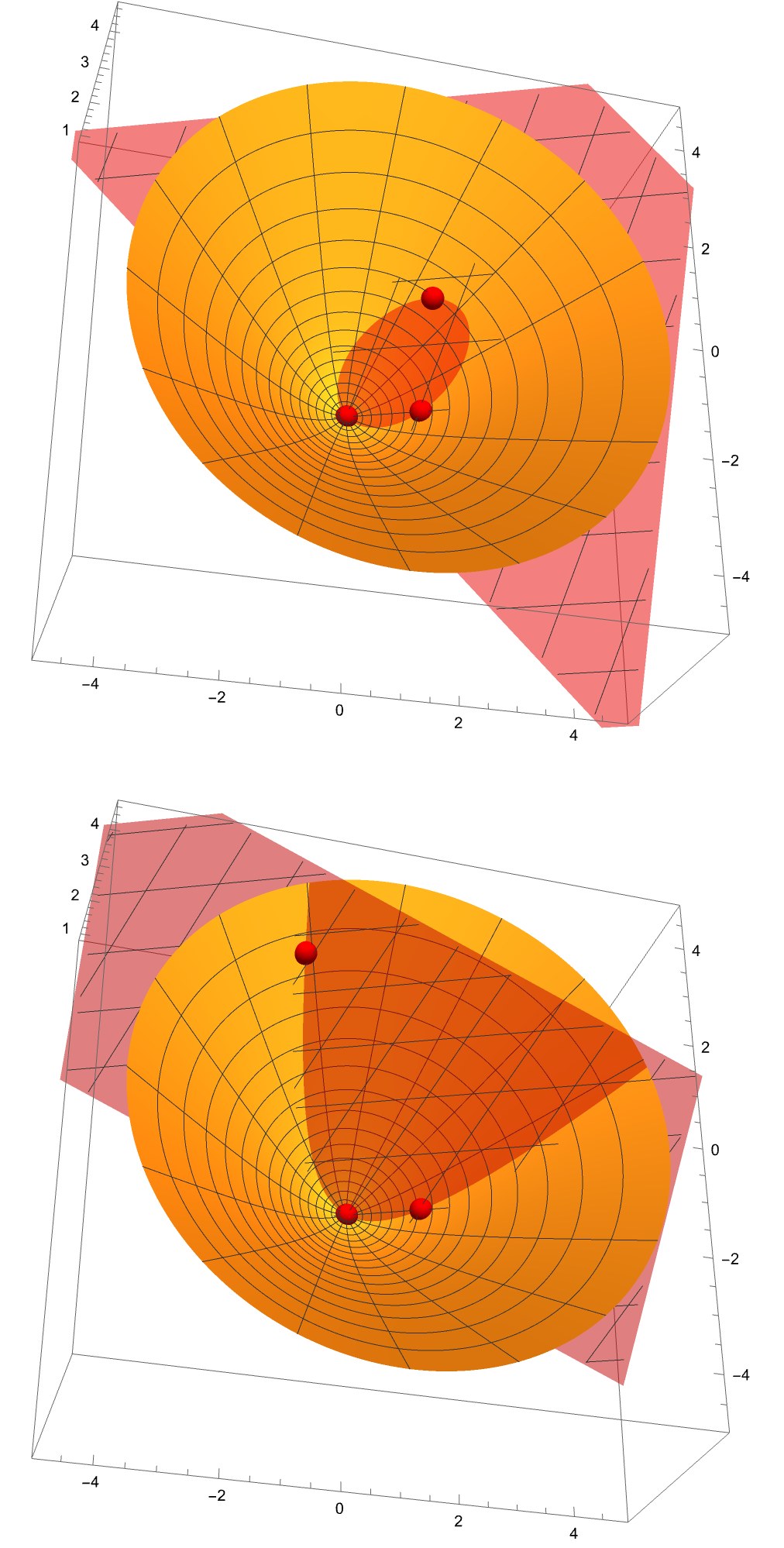
This is easiest to see if we model the hyperbolic plane as one surface of the hyperboloid −𝑡²+𝑥²+𝑦²=−1. The image shows 2 cases, where the plane through 3 points intersects the hyperboloid either in a closed curve or an open one, with the latter corresponding to a hypercycle.
If we pick 2 points at random in a disk in the hyperbolic plane with radius ρ around our 3rd point, what is the probability that those 3 points *will* lie on a circle?
This turns out to be:
-1/4*(ArcCos[1 - 2*Sech[ρ/2]^2]*(-4 + Csch[ρ/2]^4))/π +
(Csch[ρ/2]^4*(3*π + 36*ArcTan[Tanh[ρ/4]] - 30*Sinh[ρ/2] + 2*Sinh[(3*ρ)/2]))/(12*π)
which starts at 1 for ρ=0, falls to about 3/4 at ρ=1, and approaches 0 as ρ→∞.