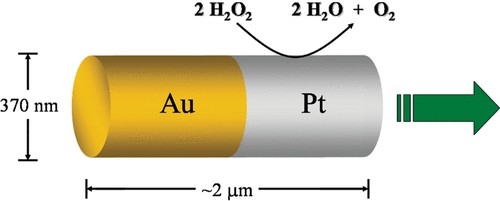
SELF-PROPELLED PARTICLES Take a tiny rod with one half made of gold and the othe...
John Carlos Baez @johncarlosbaez@mathstodon.xyz
SELF-PROPELLED PARTICLES
Take a tiny rod with one half made of gold and the other made of platinum. Put it in hydrogen peroxide. It will start to move!
The platinum end catalyzes a reaction where hydrogen peroxide turns into water and oxygen, and this pushes the rod along. It can move 10 times its own length every second - comparable to the speed of a bacterium with flagellae!
This experiment was first done in 2004. By now people have studied a wide variety of self-propelled particles:
https://en.wikipedia.org/wiki/Self-propelled_particles
Many are Janus particles, with two sides made of different materials:
https://en.wikipedia.org/wiki/Janus_particles
The term 'Janus particle' was invented by Leonard Wibberley in his 1962 novel The Mouse on the Moon - it was his name for a device for space travel. The term was first used in science in 1988, to describe tiny glass spheres with a coating that makes one hemisphere attract water and the other repel it. These Janus particles naturally orient themselves at the surface between water and oil.
We're just beginning to see what we can do with self-propelled particles. I expect they will become useful in some surprising ways. Can you think of something to do with them?