It's interesting that while AI attracts a lot of loud hype and haters, some math...
John Carlos Baez @johncarlosbaez@mathstodon.xyz
It's interesting that while AI attracts a lot of loud hype and haters, some mathematicians are happily using it to knock off unsolved problems. I'm not saying anyone is "right" here.
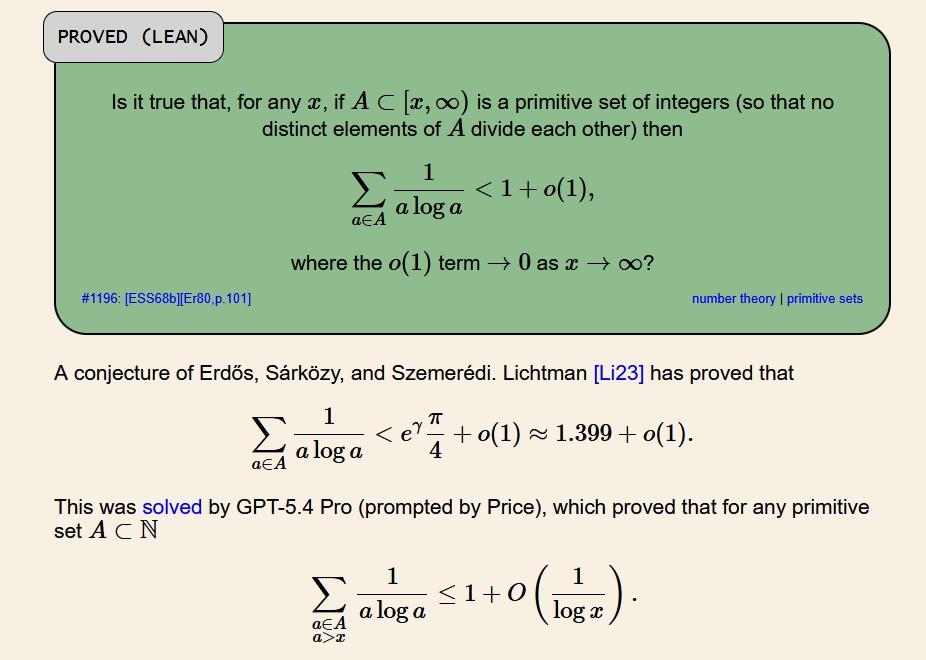
Here's the latest - thanks to @highergeometer, who follows this a lot more closely than I do. Liam Price prompted GPT-5.4 Pro to prove a conjecture of Erdős:
https://chatgpt.com/share/69dd1c83-b164-8385-bf2e-8533e9baba9c
The proof involved Markov processes. Some mathematicians used Math Inc.'s AI tool called Gauss to formalize the proof, to make sure it was legit. And yesterday, @tao reworked the proof to make it a *lot* shorter and easier to understand:
https://www.erdosproblems.com/forum/thread/1196#post-5521
Markov processes don't show up in this new proof!
Mathematicians are still scratching their heads about precisely how GPT-5.4 Pro came up with its proof. Terence Tao read a log of its "thinking", and wrote:
"That log was somewhat helpful, but still inconclusive at the most critical components of the problem solving process, which remain frustratingly opaque. My tentative theory is that these models are still quite weak at developing strategy and constructing novel coherent narratives (as opposed to explaining existing, human-generated, narratives, for which they are now rather good at); this may also be related to the tendency of AI-generated proofs (such as this one) to dwell at length on rather routine components of an argument, while not stressing the most original and important aspects of a proof."