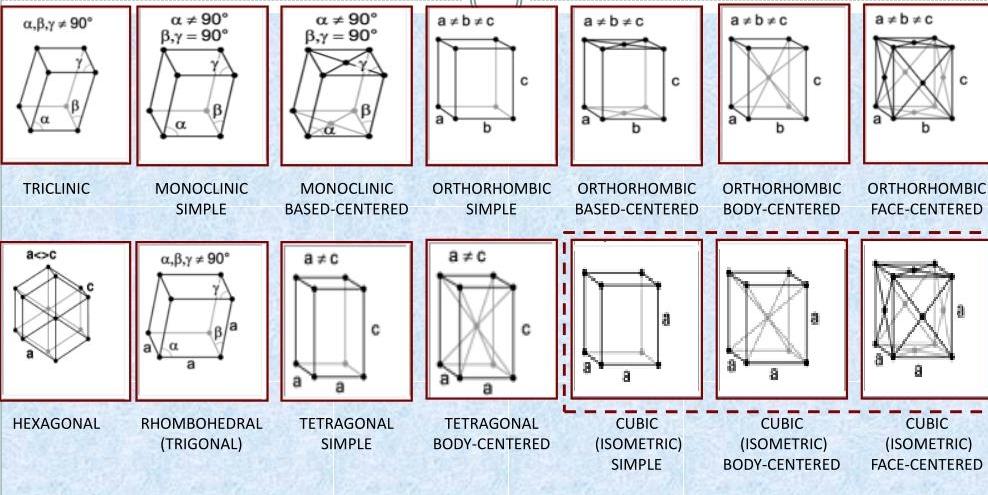
Crystallography is a rich yet confusing source of ideas in mathematics - confusi...
John Carlos Baez @johncarlosbaez@mathstodon.xyz
Crystallography is a rich yet confusing source of ideas in mathematics - confusing because there are at least 10 mathematically distinct ways to classify crystals, not even counting the many different notation systems and terminologies.
But let's dip our toe in the water! It's all about lattices and their symmetry groups.
A 'lattice' is a discrete nonempty subset L ⊂ ℝⁿ closed under addition and subtraction. This is the same as a subgroup ℝⁿ of isomorphic to ℤᵏ for some k. k is called the 'rank'. If k = n, we say our lattice has 'full rank'. Henceforth when I say 'lattice', I always mean a lattice of full rank. That's pretty common in math, though crystallographers call it a 'Bravais lattice'.
The 'Bravais group' of a lattice L ⊂ ℝⁿ is the group of all maps f: L → L that preserve distances. It's also the group of all maps f: ℝⁿ → ℝⁿ that preserve distances and map L to itself. When we talk about 'a Bravais group', we mean the Bravais group of some lattice.
In 3 dimensions, there are 14 Bravais groups - up to isomorphism, as abstract groups. You can see how they work in the picture, or in more detail here:
https://en.wikipedia.org/wiki/Bravais_lattice#In_3_dimensions
But this is just the start of classifying crystals, because there's more to an actual crystal than a mere lattice. Some *subgroups* of Bravais groups are also important!
(1/n)