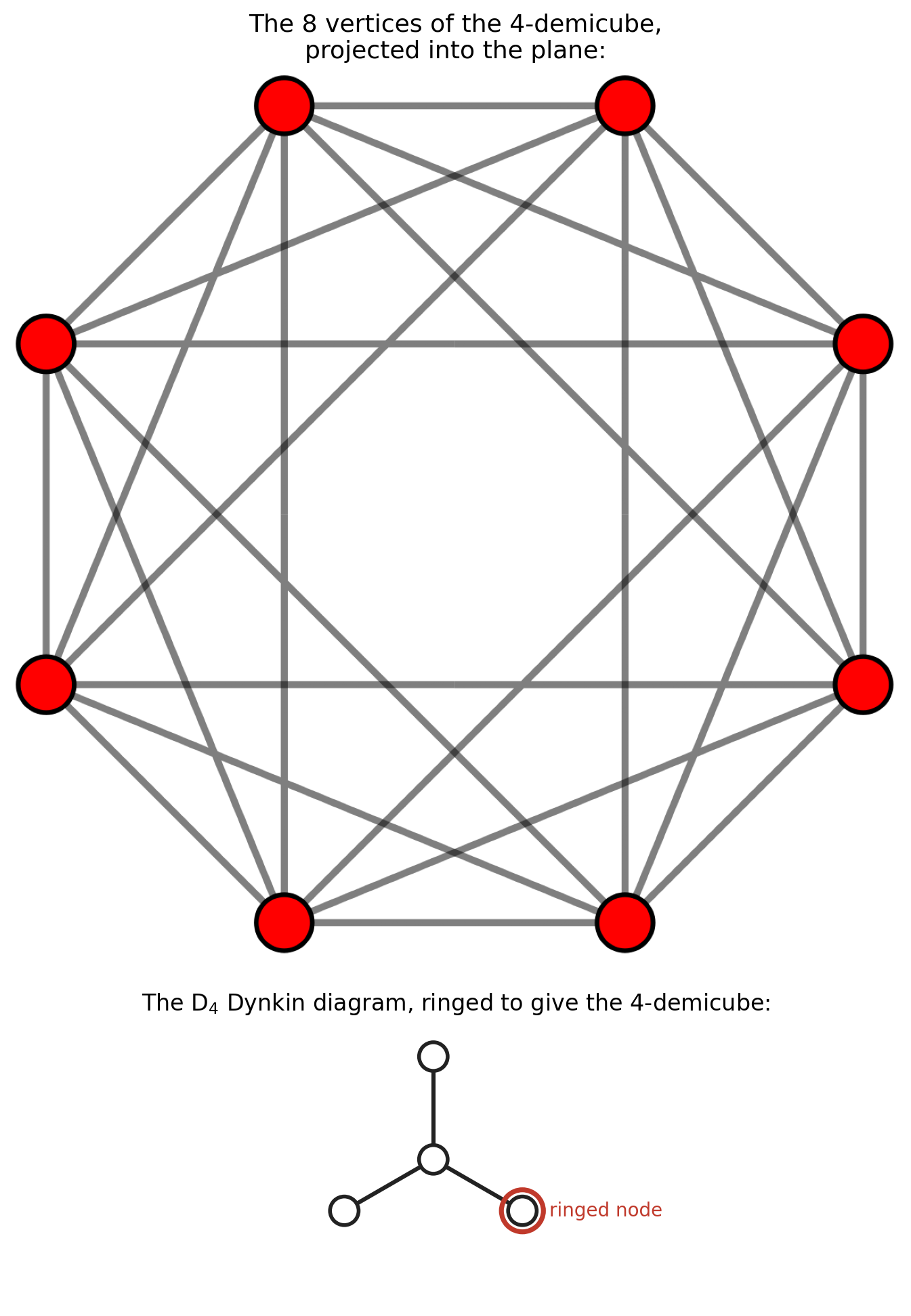
Here's some crazy geometry in 4, 5 and 6 dimensions: The 4-demicube has 8 vertic...
John Carlos Baez @johncarlosbaez@mathstodon.xyz
Here's some crazy geometry in 4, 5 and 6 dimensions:
The 4-demicube has 8 vertices. It lives in 4 dimensions.
You get it from a 4-dimensional cube - which has 16 vertices - by keeping every other vertex, throwing away half. That leaves 8.
What are its top-dimensional faces, aka 'facets'? Surprise: there's only one kind! All of them are regular tetrahedra.
In higher dimensions the demicube has two kinds of facet - one from the cube's corners, one from the cube's facets. But in 4 dimensions the two kinds happen to be the same shape: the tetrahedron! That's why the 4-demicube is especially symmetric: it's actually one of the 4-dimensional regular polytopes, the 16-cell (the 4-dimensional cousin of the octahedron).
You can read all this off the D4 Dynkin diagram, if you know what you're doing. This diagram is a central node with three arms, each just 1 edge long: a perfectly symmetric three-pronged star. To get the 4-demicube, you ring the tip of any one arm.
To get the faces, delete an unringed node so the piece still holding the ring stays connected, and see what diagram survives. There are two choices: you can delete the tip of either other arm. Either way, what's left is a straight chain of 3 nodes - the so-called A3 diagram, whose polytope is the tetrahedron.
Both choices give the same shape of facet, a tetrahedron, because all three arms of the D4 Dynkin diagram are interchangeable. That ceases to be true in higher dimensions!
(1/n)