A vector looks like an arrow; anyone studying math or physics in college learns ...
John Carlos Baez @johncarlosbaez@mathstodon.xyz
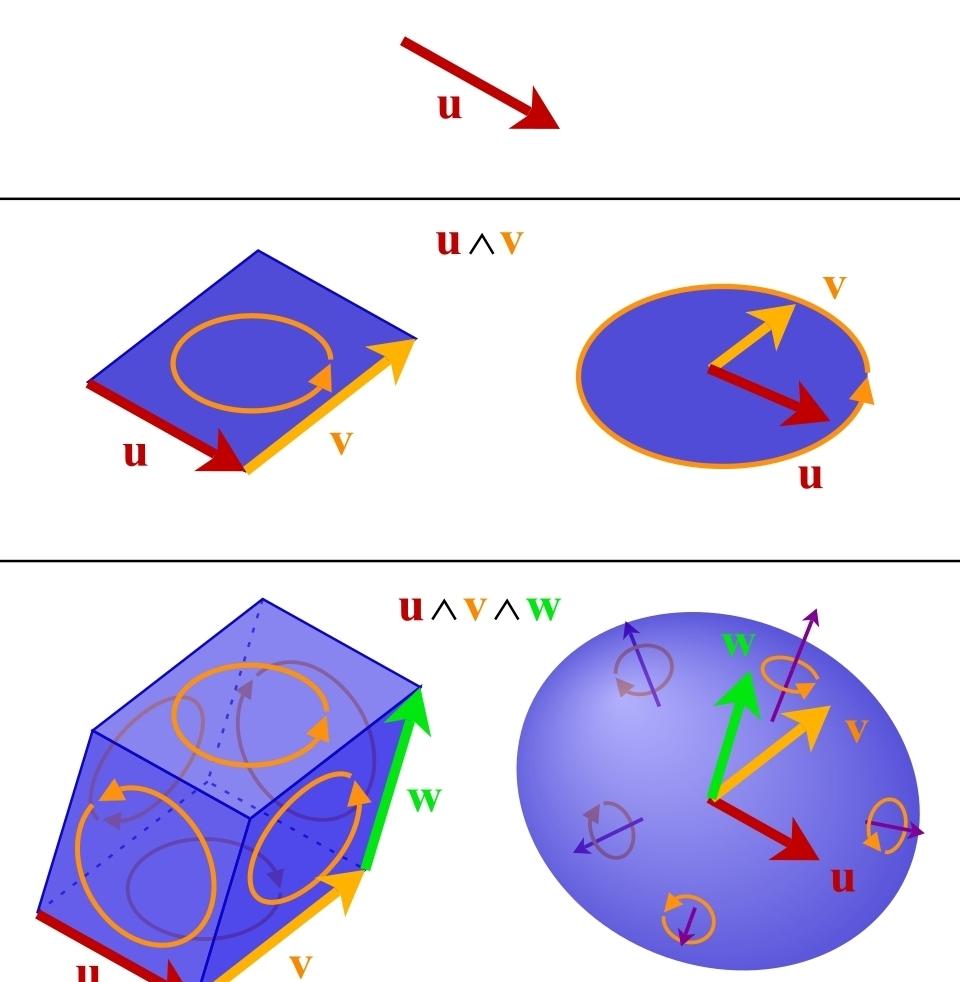
A vector looks like an arrow; anyone studying math or physics in college learns about these.
Bivectors are important too - though less widely taught. You can create a bivector by taking the 'wedge product' u ∧ v of two vectors u and v, and you can visualize this as the parallelogram shown at left here.
But in fact, an ellipse or any other flat surface with the same area lying in the same plane is just as good a picture of this bivector. Further, you can add bivectors, so there are bivectors like u ∧ v + w ∧ z that you can't picture as just a single surface.
Thus, you need to be good at the algebraic manipulation of bivectors to keep from making mistakes: unlike with vectors, the picture is just a rough indication of what's going on. Yet bivectors are extremely important.
For example, while the electric field is a vector field, the magnetic field is really a bivector field. In 3d space we can convert bivectors into vectors using a trick called the 'cross product': we replace u ∧ v with a vector called u × v. So that's what they teach us in college, to avoid talking about bivectors. But this trick requires an awkward 'right-hand rule', and in higher dimensional space it doesn't work at all.
You can go on and define trivectors, etc., and some of the same issues show up.
So now let's talk about the classification of trivectors in 9-dimensional space.
[Typical way a math professor gracefully transitions to what they really wanted to talk about.]
(1/n)