It's Hamilton's Day! For a long time Hamilton was trying to invent a 3-dimension...
John Carlos Baez @johncarlosbaez@mathstodon.xyz
It's Hamilton's Day! For a long time Hamilton was trying to invent a 3-dimensional number system where he could add, subtract, multiply and divide. Finally, on the 16th of October, 1843, he realized that he needed a 4-dimensional number system - now called the quaternions. While walking with his wife along the Royal Canal to a meeting of the Royal Irish Academy in Dublin, he made his momentous discovery:
"That is to say, I then and there felt the galvanic circuit of thought close; and the sparks which fell from it were the fundamental equations between 𝑖, 𝑗, 𝑘; exactly such as I have used them ever since."
And in a famous act of mathematical vandalism, he carved those equations into the stone of the Brougham Bridge.
Given such a romantic story, Tevian Dray and I could not resist trying to find this bridge when we were attending a conference on general relativity in Dublin - especially because we're both fans of the quaternions less-beloved kin, invented by Hamilton's friend John Graves: the octonions! So, on July 21st, 2004, we set out with a group of friends to find it.
Getting there was quite an adventure. But I hear it's gotten much simpler since 2004: I think now the 'Luas' green line tram runs through the city center directly to its terminus at Broombridge.
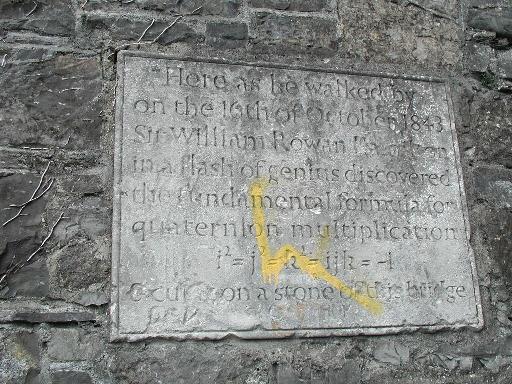
Hamilton's original carving is long since lost, but there's a plaque to commemorate his discovery. Unfortunately it's covered with graffiti, perhaps a form of poetic justice.
The text says:
Here as he walked by
on the 16th of October 1843
Sir William Rowan Hamilton
in a flash of genius discovered
the fundamental formula for
quaternion multiplication
𝑖² = 𝑗² = 𝑘² = 𝑖𝑗𝑘 = −1
& cut it on a stone of this bridge