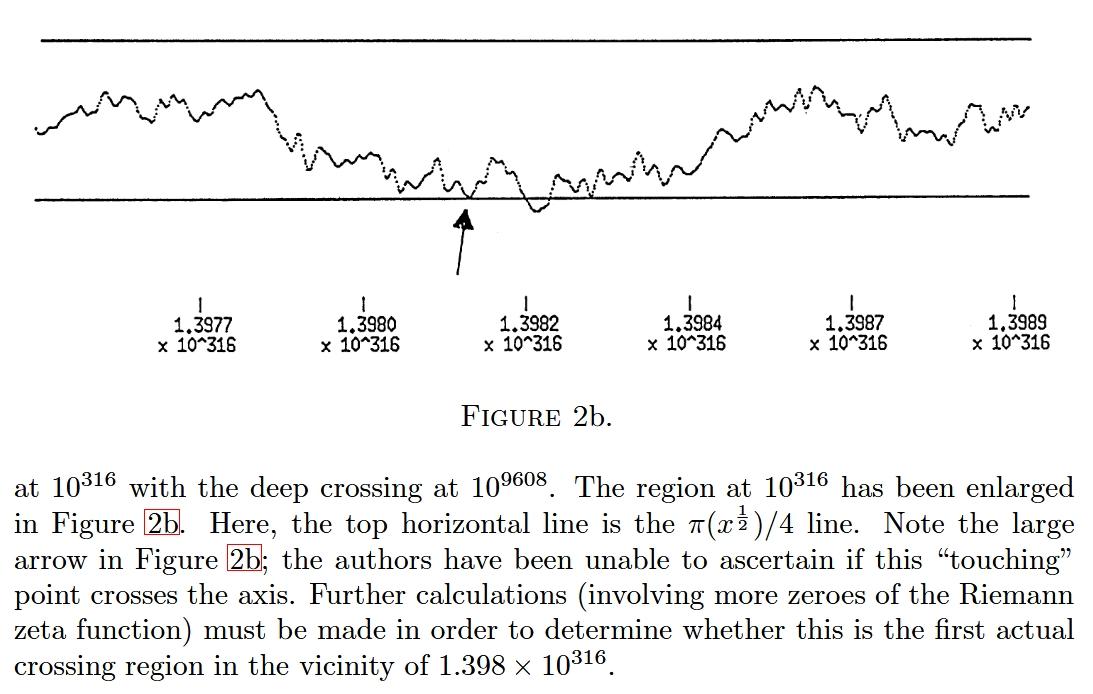
Some heroic calculations by Bays and Hudson estimate the number of primes less t...
John Carlos Baez @johncarlosbaez@mathstodon.xyz
Some heroic calculations by Bays and Hudson estimate the number of primes less than 1.39822 ×10³¹⁶ and show it drops below the function li(x), which theorems say is a good approximation. Maybe it does so a bit earlier, near the arrow. Or this could be the first place it does so.
How did they count the primes less than 1.39822 × 10³¹⁶ ? Not directly, of course! They used a formula that estimates this count using the zeros of the Riemann zeta function - and they used Odlyzko's database of the first million zeros.
Here is their paper:
• Carter Bays and Richard H. Hudson, A new bound for the smallest x with π(x) > li(x), Mathematics of Computation 𝟔𝟗(231) (1999), 1285–1296, https://www.jstor.org/stable/2585028.
It's too bad their amazing computations are accompanied by such poor graphics. This new paper with the same title may look better:
• Kuok Fai Chao, Roger Plymen, A new bound for the smallest x with π(x) > li(x), https://arxiv.org/abs/math/0509312
but I haven't checked it out yet!