The most interesting thing about this conversation with Ravi Vakil is the huge p...
John Carlos Baez @johncarlosbaez@mathstodon.xyz
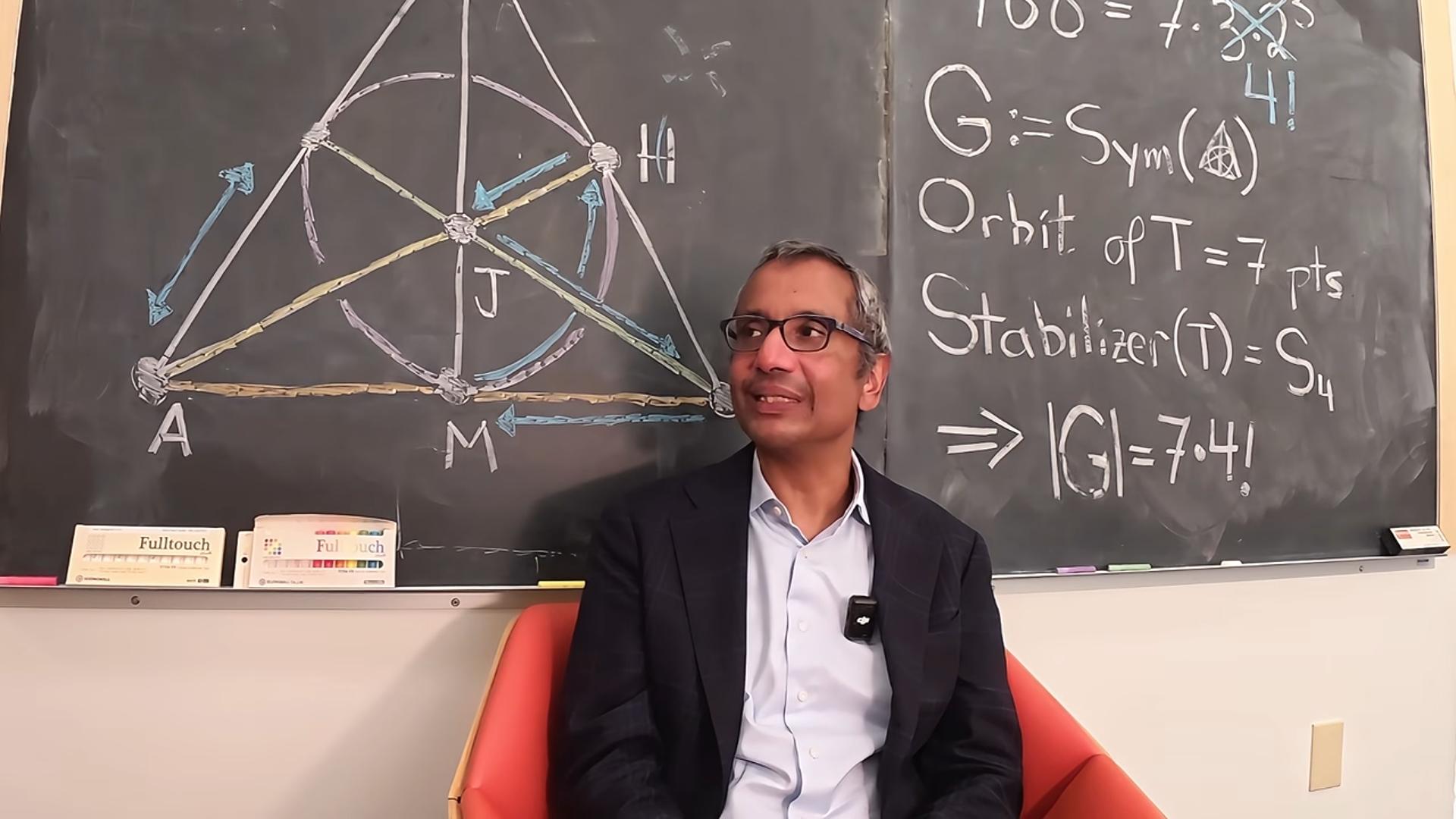
The most interesting thing about this conversation with Ravi Vakil is the huge picture and calculation on the blackboard behind him:
youtube.com/watch?v=0trpmJKKpFM
He never mentions it. Is he trying to send us a signal?
It's called the Fano plane: 7 points and 7 lines, with one of lines drawn as a circle. 3 points on each line, and 3 lines through each point. It's commonly used to describe the octonions, so maybe Vakil is secretly saying that octonions hold the key to the universe.
Or maybe not. The calculation on the board merely claims that the symmetry group of this plane, called G here, has 7⋅4! = 168 elements. It says
|G| = 7⋅4!
At the top you can see that the number 3⋅2³ is crossed out and replaced by 4!.
4! is the number of permutations of 4 things. The group of such permutations is called S₄. The board says Stab(T) = S₄. It doesn't say what T is, but it must be the name of the point on the Fano plane that's too far up to see! The 'stabilizer' of this point, Stab(T), is the subgroup of G that maps this point to itself. The 'orbit' of this point, Orbit(T), is the set of points it gets mapped to by the symmetries in G. It gets mapped to all 7 points in the Fano plane.
The 'orbit-stabilizer theorem' is a general result, which applied here says
|G| = |Orbit(T)| |Stab(T)| = 7⋅4!
That's true *if* we know the stabilizer of T is S₄. So the really interesting thing is why that's true. This must be the secret message of Vakil's talk:
FIGURE OUT WHY THE SYMMETRIES OF THE FANO PLANE FIXING A POINT FORM THE GROUP OF PERMUTATIONS OF 4 THINGS.
(Actually on YouTube someone says Vakil just happened to be sitting in someone else's office.)
(1/n)