Recently, we responded to a single-host infection that our SOC handed over to us...
Stephan Berger @malmoeb@infosec.exchange
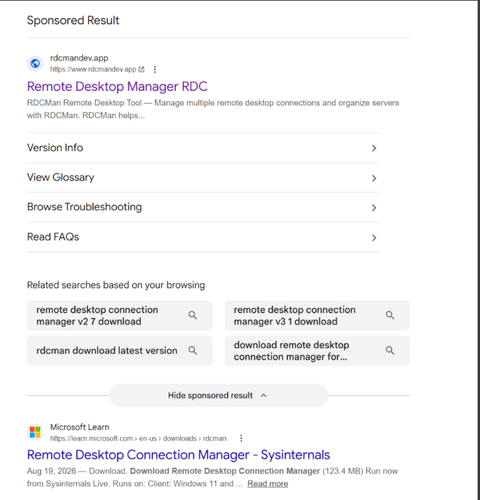
Recently, we responded to a single-host infection that our SOC handed over to us. The user downloaded a malicious "Remote Desktop Connection Manager" - well, actually, a legitimate tool developed by Microsoft- but attackers were now misusing the brand. See the first screenshot, where the user followed a classical malvertising, landing on the site in the second screenshot.
After downloading and running the installer (leading to an infection), the attackers had full access to the infected device (and leveraged that access to take screenshots via PowerShell (more on that on another tweet) and use SSH to pivot to the internal network). The RAT was ChainScript, as nicely depicted here. [1]
As soon as we took over this case, we began hunting inside the network for traces of lateral movement and/or similar techniques (TTPs, IOCs). Additionally, we found 3 additional infected computers with the same malware, with infections occurring in a short time span.. which was like.. what happened here?
It turns out the devices belonged to employees on the same team, and the employee who had the first infection pasted the malicious link in a Teams Chat, encouraging the rest of the team to install the same software from the same malicious site (d'oh).
So the saying could not be truer: Trust, but verify. Always download trusted software from legitimate sites; as this example shows, an infection (infections!) can happen within minutes.
[1] https://blackpointcyber.com/blog/chainscript-tracing-a-nodejs-rat-across-the-blockchain/