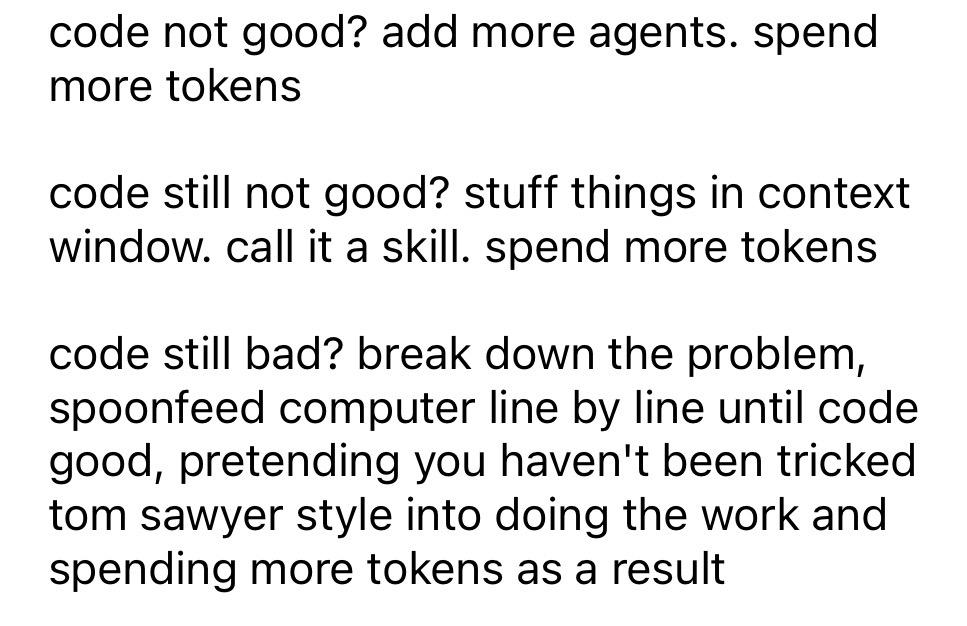
This is IMO just buying into the industry’s framing. There are other ways to use...
mnl mnl mnl mnl mnl @mnl@hachyderm.io
This is IMO just buying into the industry’s framing. There are other ways to use #llms #llm #ai and plenty more to be discovered.
They transform language, some patterns are easier to transform than others. In normal terms we call that programming language theory, some languages make it easier for humans to express ideas formally in a way that makes them easier to manipulate.
We don’t fetishize C (well, some do…) because it’s harder to do proper memory management and requires “more thinking”, we just realize it’s kind of pointless thinking to have to remember to free memory (pun intended), and invent languages where that is not needed, and we can more easily rely on writing things left to right (or more generically, being able to compose words that refer to concepts that also compose).
No one is going to be surprised that a language model transforms “make a modal to confirm file deletion” to “confirmationModal.warning(“confirm deletion”)” and yet that is almost its purest computational essence and what all our frameworks strive for.
“Make a confirmation modal with elegant api” resulting in “confirmationModal.warning = ui.modal.text(_, style=warning)” won’t surprise anybody either. Yet all the llm needed was the prompt “elegant API” and the rest almost falls into place by itself, meta-circular evaluator style.
Some concepts don’t compose easily and are hard to decipher (for us, and by way of training corpus, llms), and require hard thinking. “How do I compose showing modal with running hardware jobs? Should I stop the job immediately? Should I ignore it but the modal then makes it hard to act on the job itself, while its action might properly be deferred? Should a modal be dismissible? Delayed? Queued? Are only some hardware jobs non-interruptible? …”
Trust me, there is plenty of thinking and writing out “code” to be done.