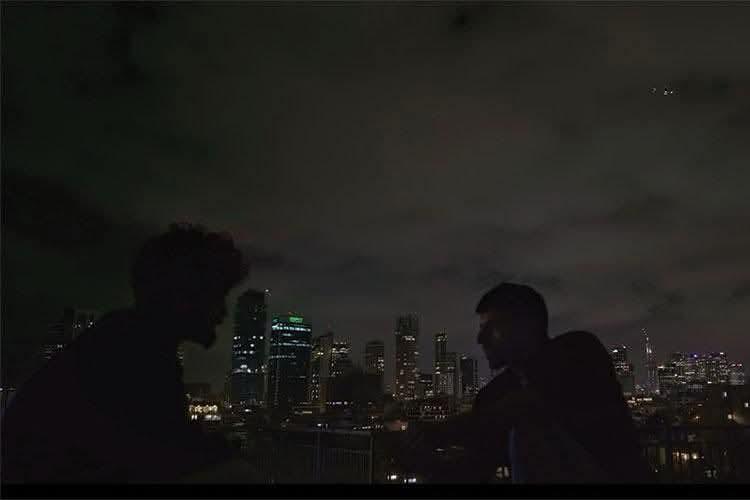
The description of NAZA by Calgary community organiser Saima Jamal: NAZA in Hebr...
Ned Yeung 🍉 @ned@beige.party
The description of NAZA by Calgary community organiser Saima Jamal:
NAZA in Hebrew means “collateral damage” - the innocent people killed during war.
Before I went to see this film, friends had sent me the trailer and articles about it. I read that it received the longest standing ovation at the Venice Film Festival. I read the Israeli military’s statement condemning it.
None of that prepared me for what I witnessed today inside a packed Chinook Cineplex theatre, at the Calgary International Film Festival on a Tuesday afternoon.
Before the screening began, a CIFF representative told us that NAZA had been added to the festival very late. Within 24 hours of its announcement, it was almost sold out - and Chinook has a large theatre.
And then the lights went down.
NAZA is co-directed by Israeli journalists and filmmakers Yuval Abraham and Rachel Szor, best known for their Academy Award-winning documentary No Other Land (2024).
What follows is horrifying precisely because of how calmly it is told.
Yuval interviews IDF soldiers and intelligence personnel, sitting in the darkness of night on a rooftop in Tel Aviv. There is no dramatic music. No screaming. No theatrical performance.
Just men & women speaking matter-of-factly about what they did in Gaza.
They describe how, after October 7, they wanted to fight for their country. They describe how they calculated where and when to drop bombs.
They knew where people were.
They listened to their phone calls.
They could hear wives talking. Children under 10. Babies crying.
And yet, they describe decisions to strike homes when families were inside.
Ten civilians. Twelve. Twenty. One hundred. Sometimes 500.
The film depicts a system where the presence of civilians - people they referred to as NAZA - could be treated as an acceptable cost, even when the target was a low-level Hamas operative.
And sometimes, according to the testimonies presented in the film, they didn't even know for certain that a militant was there.
Predictions were enough.
A neighbourhood. A building. A bakery.
Bomb it.
One soldier describes visiting Poland and seeing what Nazi Germany did to Jews. He says he wondered how Germans could do those things to his people and then simply go home.
Then he says something chilling:
Now he understands how they did it. Because he did it in Gaza.
At one point, a soldier is asked whether he believes what happened in Gaza amounted to genocide.
His answer is yes. Because the intention was to kill NAZA. Innocent people.
The soldiers describe killing a young boy who wandered into a restricted area. They describe killing people running desperately toward food aid, comparing them to ants.
They draw maps of buildings, floors, gardens and pathways, explaining how homes were destroyed one after another.
And when homes remained standing, the film describes soldiers going house to house and burning them - using whatever was available, including olive oil and flammable wool from pillows - with the intention of making it impossible for Palestinians to return and forcing them out of Gaza.
I have spent the last three years watching Gaza unfold before our eyes.
I thought I had seen everything.
I hadn't.
What makes NAZA different is that it presents testimony from the perpetrators' perspective - accounts from Israeli soldiers and intelligence personnel describing what they say they witnessed and participated in.
There were no graphic images needed to break me.
I tried so hard to stay composed.
I couldn't.
I cried. And I cried hard.
At the end, the theatre fell completely silent.
Then came applause.
But even as people began leaving, many simply remained in their seats.
They couldn't move.
They were stunned. Processing what they had just heard.
I looked around and realized that I wasn't the only one trying to understand how human beings could describe these things so calmly.
This film has been banned in Israel, and the filmmakers have faced severe consequences including getting theur Israeli citizenship stripped off. Israeli authorities have denied the film's portrayal and the testimonies presented in it saying computer technology/ AI doesn't determine who gets bombed but these soldiers talk in detail how people congratulated them for creating this technology to mass kill Palestinians.
Today was the first screening of NAZA in Canada.
I desperately hope it is not the last.
I hope it is shown in theatres across this country.
If you can see it in a theatre, go see it.
If you can't, find a way to watch it.
I heard NAZA will be FREE for all to see online soon.
If you belong to a mosque, church, synagogue, community organization, university, school, human-rights group or any other community - organize a screening.
And if you want another Calgary screening, email CIFF at info@ciffcalgary.ca and ask them to bring NAZA back.
Because these testimonies need to be heard.
They need to be documented.
They need to be confronted.
And whatever history ultimately says about this period, these voices must never be erased.
We cannot look away.
We cannot forget.
#freepalestine #gaza #naza #genocide #cdnpoli #ableg #abpoli #yyc #yeg