Shipping giant Maersk admits breach, denies darkweb attack claims. About 10 days...
Paul Ducklin @pducklin@infosec.exchange
Shipping giant Maersk admits breach, denies darkweb attack claims.
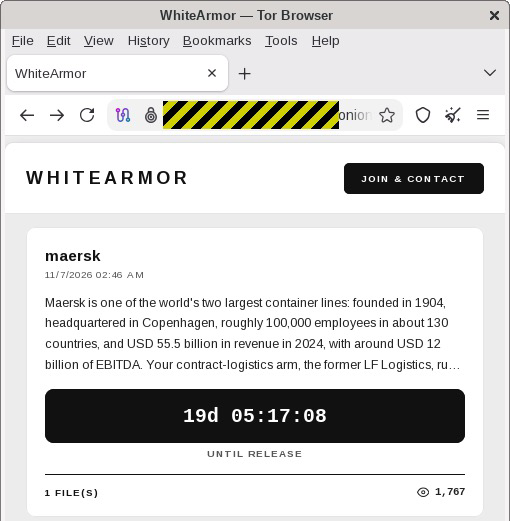
About 10 days ago, Maersk was blackmailed on the darkweb site of a cyber-extortion gang going by WhiteArmor.
The criminals made a bold claim to have stolen 100GB of data from a Hong Kong-based logistics company that Maersk acquired back in 2022, saying it had the following data, and demanding a blackmail payout:
"29,297 driver records, 16,093 of them with plaintext passwords
16,123 staff accounts, including 33 SUPER_ADMIN accounts
18,913 delivery recipients with names and street addresses
64,665 signed delivery receipts (214,107 documents in total)
14.44 million inventory rows, 189,248 purchase orders, 334,432 ASNs
27,842 mobile device logs containing phone numbers, emails and IMEIs
You have 30 days to contact us and pay USD 5,000,000 in bitcoin
Emails with instructions will be sent to you shortly."
A pseudo-anonymous Session ID and a Proton Mail address were provided, too, just in case.
Maersk countered by saying, "Our findings so far strongly suggest no sensitive data has been disclosed. The incident is isolated to a local system," and telling a reporter that "The claims about passwords are not accurate. Passwords for the system are stored in protected form."
Protected form probably means they were salted-and-hashed.
This way, the system can verify that a login password is correct by salting-and-hashing it again, and checking the result against the database, without ever needing to store the raw password.
In contrast, anyone who stole that database of hashes couldn't (or at least couldn't easily) work backwards to recover the plaintext of the password. (Plaintext is jargon for "raw, unscrambled form.")
Maersk didn't explicitly say that password hashes were not stolen, so it might think that password hashes don't count as "sensitive data" even if the attackers did get hold of them, or it might just be backing its early findings that nothing seems to have been stolen.
(Many experts might suggest that hashed passwords do count as "sensitive data." That's because they can cracked by brute force - albeit very slowly - by trying a list of likely passwords in sequence, with the most likely passwords at the top of the list being the first to fall.)
As an aside, in a list of stolen passwords that were indeed properly salted-and-hashed, only the very poorest password choices (such as 12345678, pa55word, or nameofcat) are likely to be crackable in a timeframe that's useful to the criminals. Well-chosen passwords might survive months or years of cracking, or even longer, giving potential victims plenty of time to change them to make their previous hashes worthless. That's why not taking shortcuts with your passwords is well worth it!
Maersk has promised to update its online report as it finds out more, and to notify anyone it thinks might actually have had data stolen after all.