Some tilings of the plane by the turtle aperiodic monotile contain infinite conn...
Pieter Mostert @pieter@mathstodon.xyz
Some tilings of the plane by the turtle aperiodic monotile contain infinite connected sequences of tiles that can be rearranged to tile the same path in two different ways. Call these paths 'worms', after Conway worms in Penrose tilings (see https://www.ams.org/bookstore/pspdf/car-36-prev.pdf for example).
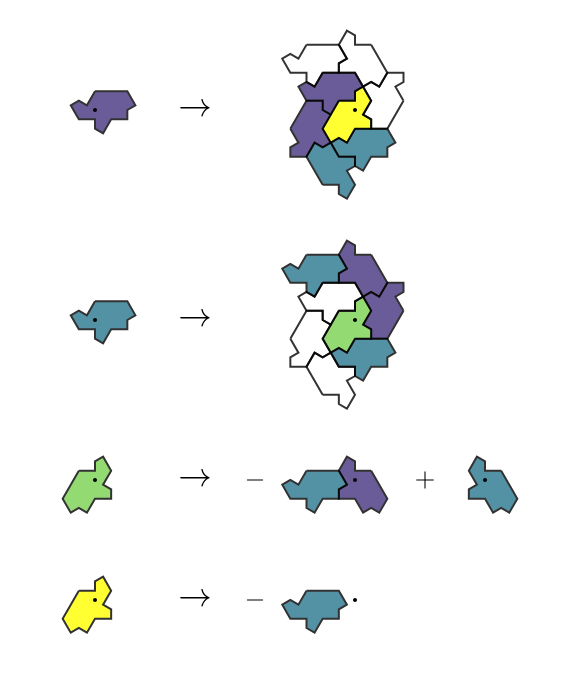
Given a turtle tiling with a worm, you'd expect that its inflation or deflation would also contain a worm, but how does one worm generate another? There are a few ways of describing the process; the one I describe here involves negative tiles, but if you prefer you can group them to get a system where all tiles are conventional.
Tiles are called even or odd according to whether their handedness is more frequent or not. We'll consider tilings where the even tiles are left-facing turtles.
The substitution depends on using two colours for both even and odd tiles, as shown in the first figure (well, tiles can also be white - these are tiles that don't form part of the worm in the deflated tiling - and their deflation is the same as the deflations of the coloured tiles, except all tiles are white.)
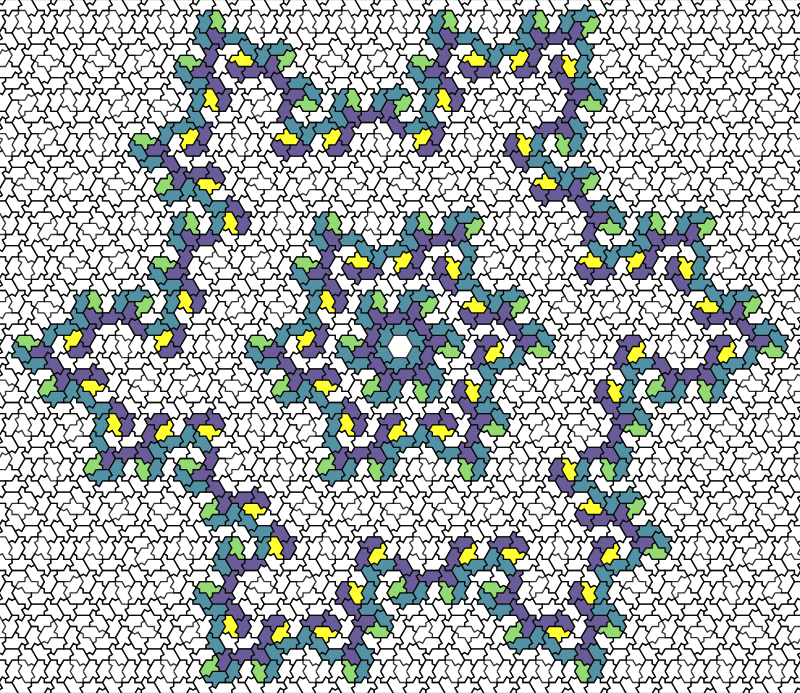
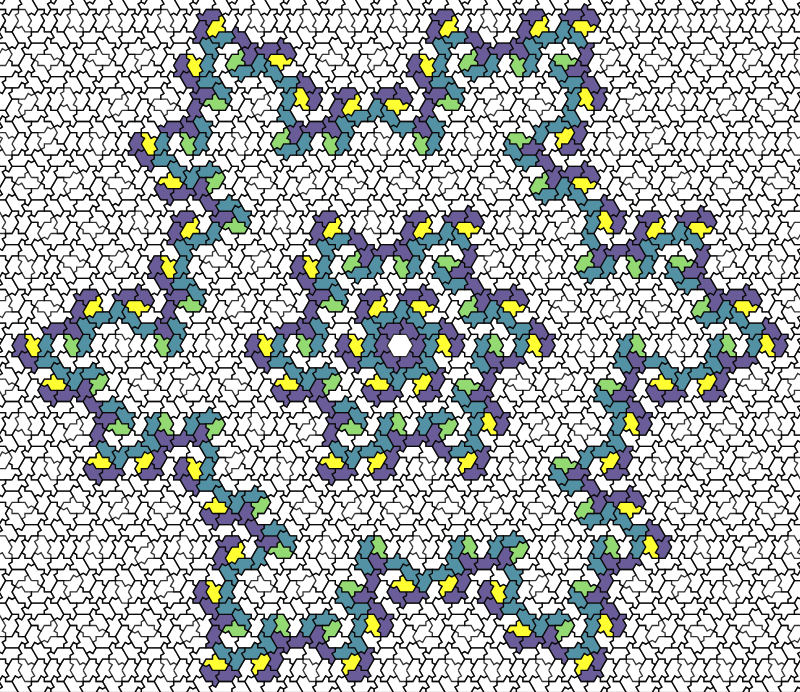
The second and third figures show tilings of a hexagon surrounded by turtles, with two tilings of the worms. While this isn't a tiling of the plane, it has the nice property that the six turtles surrounding the hexagon fit inside their deflation, which means every deflation fits inside the next.
If you're wondering if you can do a similar thing for Spectre tilings, I'm pretty sure you can, but I haven't worked out the details yet. This is a bit more interesting in that there are two types of worms, one wrigglier than the other, and deflation sends one type to the other.