For #TilingTuesday, I'd like to introduce an infinite family of aperiodic Wang t...
Pieter Mostert @pieter@mathstodon.xyz
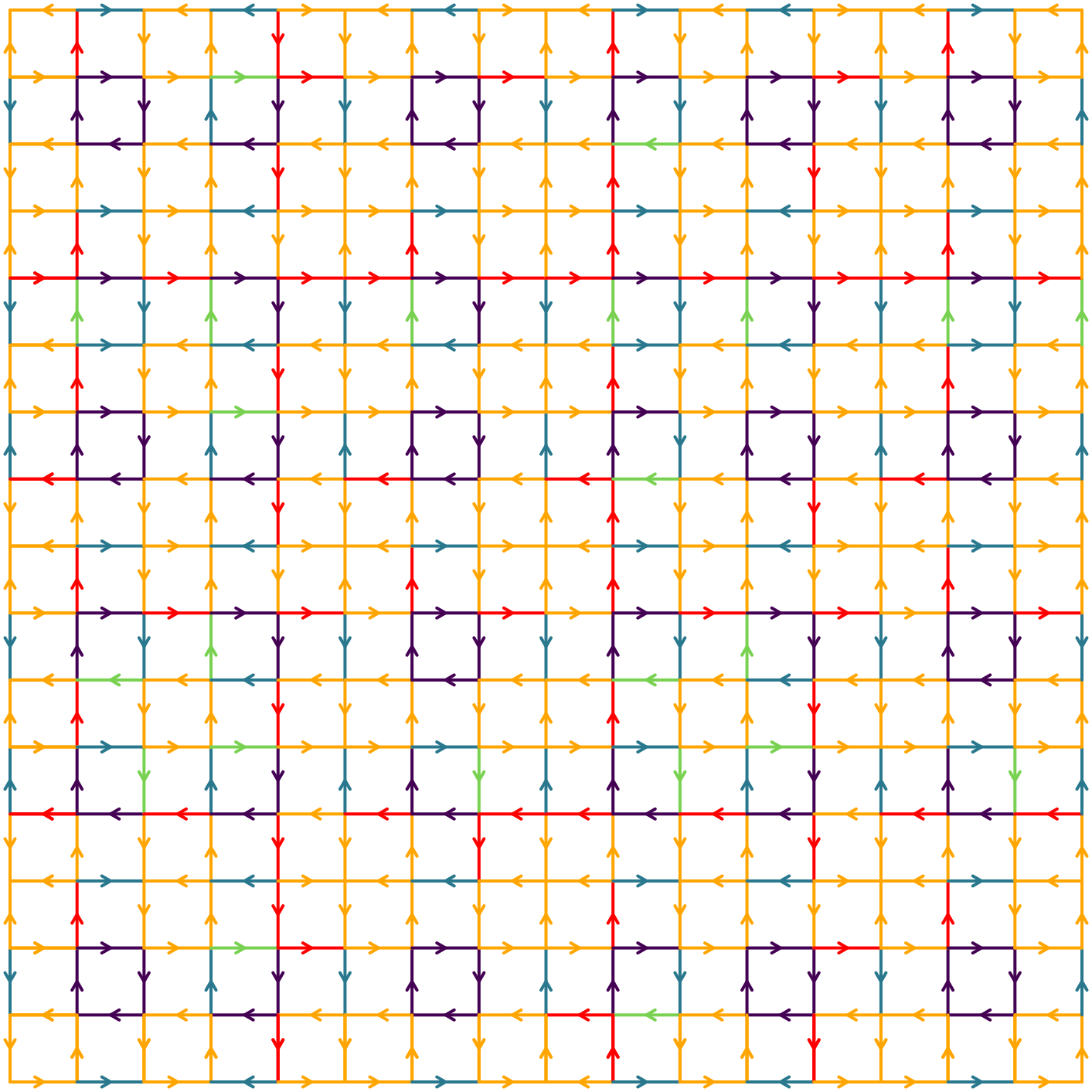
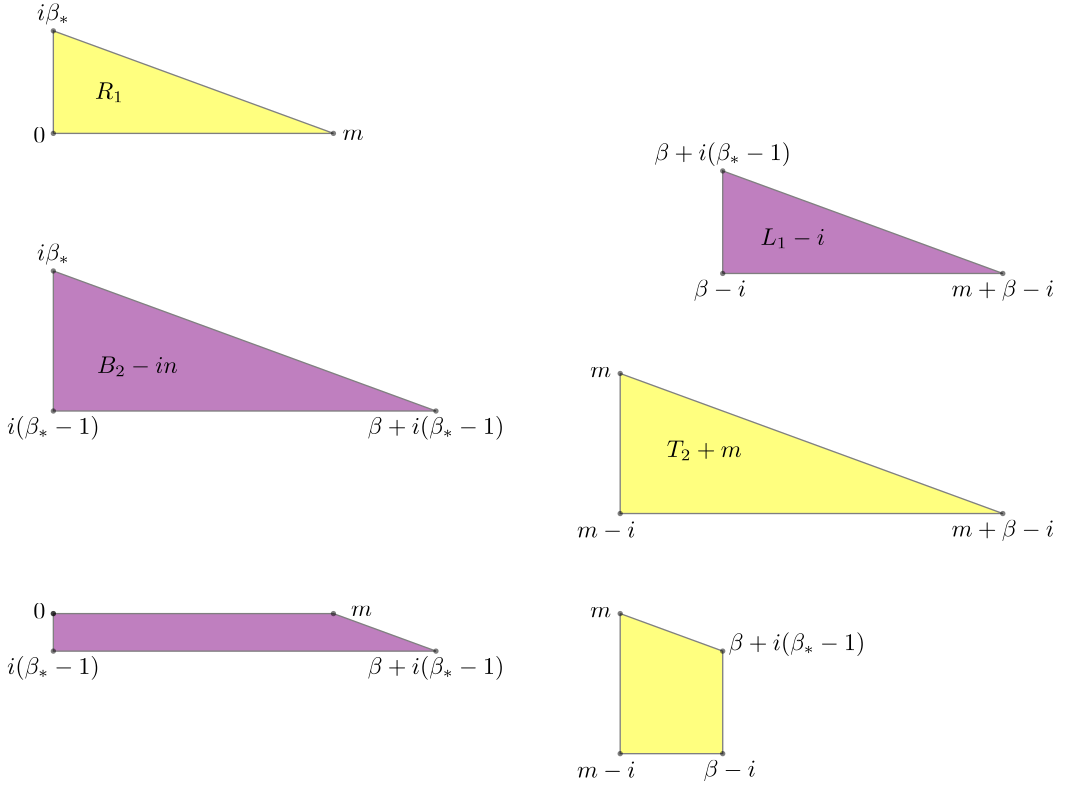
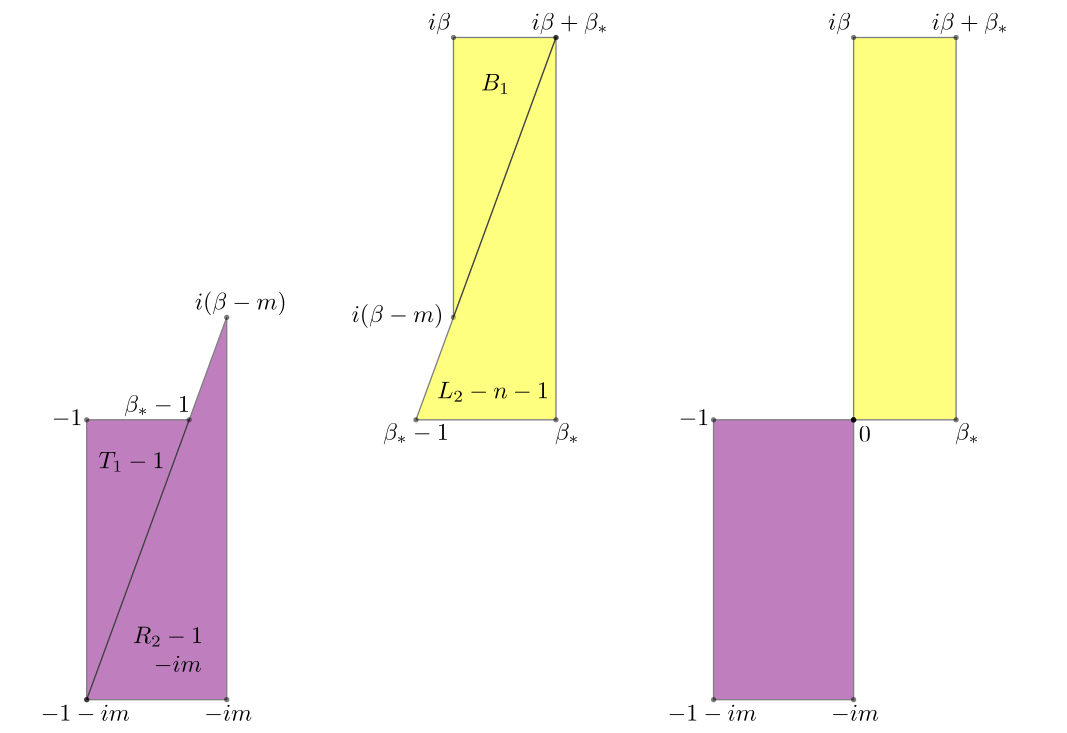
For #TilingTuesday, I'd like to introduce an infinite family of aperiodic Wang tile sets, two for each real algebraic quadratic integer that is not the square root of a natural number. This generalises Sébastien Labbé's metallic mean tiles (see https://arxiv.org/abs/2312.03652 and https://arxiv.org/abs/2403.03197), and the construction lends itself to a different proof of aperiodicity (basically "proof by Tangram" plus a bit of algebra) that avoids the need to prove a tiling hierarchy. If you're interested in the details, you can find them here:
https://drive.google.com/drive/folders/1AzhobFNKL0cGboXaJ7thnEl6SAvq8C3l?usp=sharing,
but I thought it would be nice to demonstrate the argument for a concrete example.
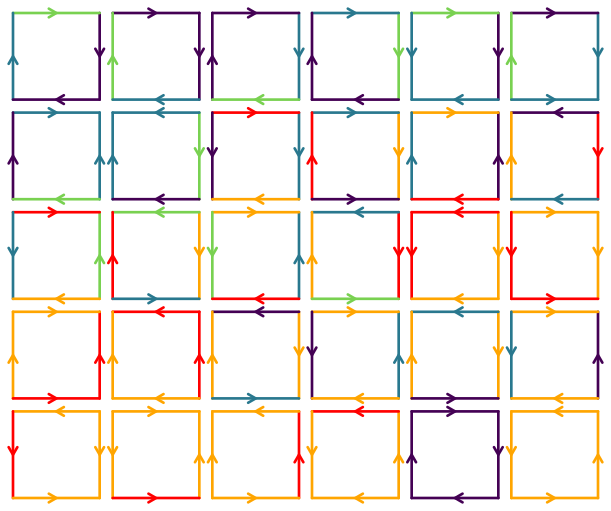
Consider the set of 30 tiles shown in the first image, which can be considered Wang tiles if we assign colours to edges depending on the colour and direction of the arrows. Notice that if one side is red or orange, so is the opposite side. Thus we can categorise the tiles into four groups, depending on whether the vertical edges are red/orange and whether the horizontal edges are red/orange.
Suppose there was a periodic tiling with these tiles. Then we could find a square repeating unit. Let \( n \) be the number of its rows. Each row must either have all vertical edges red/orange, or none. Likewise each column must have all horizontal edges red/orange, or none. Let \( x\) and \( y \) be the number of red/orange columns and rows, respectively. Then in the repeating unit, the numbers of tiles with all edges red/orange, only vertical red/orange edges, only horizontal red/orange edge, and no red/orange edges are \( xy \) , \( (n-x)y \) , \( x(n-y) \) and \((n-x)(n-y) \) respectively.
(1/n)