As you may already know, last week Ioannis Tsiokos published a pre-print that de...
Pieter Mostert @pieter@mathstodon.xyz
As you may already know, last week Ioannis Tsiokos published a pre-print that described the first known three-dimensional aperiodic monotile: https://arxiv.org/abs/2609.19214. The pre-print was partly (possibly entirely) LLM-generated, but thankfully Chaim Goodman-Strauss has waded through the slop to extract an elegant description, from which a simple computation-free proof of aperiodicity follows: https://arxiv.org/abs/2609.24779v1
The only point glossed over is that every tile in a tiling lies inside a unique supertile; Chaim describes this as something that can be verified by the active reader with a few moments experimentation. While this may be true, I thought it would be useful to spell out the argument in a bit more detail, although there are still a few unjustified claims which involve checking a small number of cases.
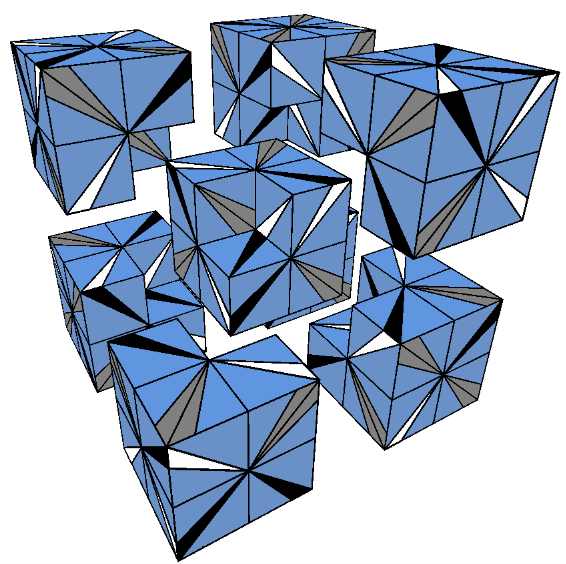
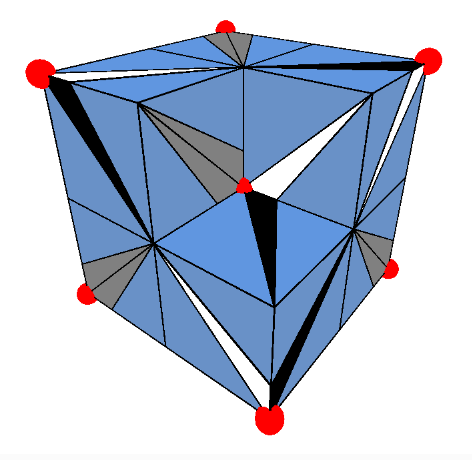
To illustrate the argument, we'll use a representation with stylised arrows where black must meet white and grey must meet grey. See https://editor.p5js.org/pieter_mostert/full/6Cs7ZBnfJ for an explodable view of a supertile. A helpful observation is that the vertices marked in red in the following model must match, since they correspond to the heads of the grey arrows: https://editor.p5js.org/pieter_mostert/full/6ILfw5oyc
Call these _key_ vertices. The _central_ key vertex lies in the notch, and the others are _outer_ key vertices.
(1/3)