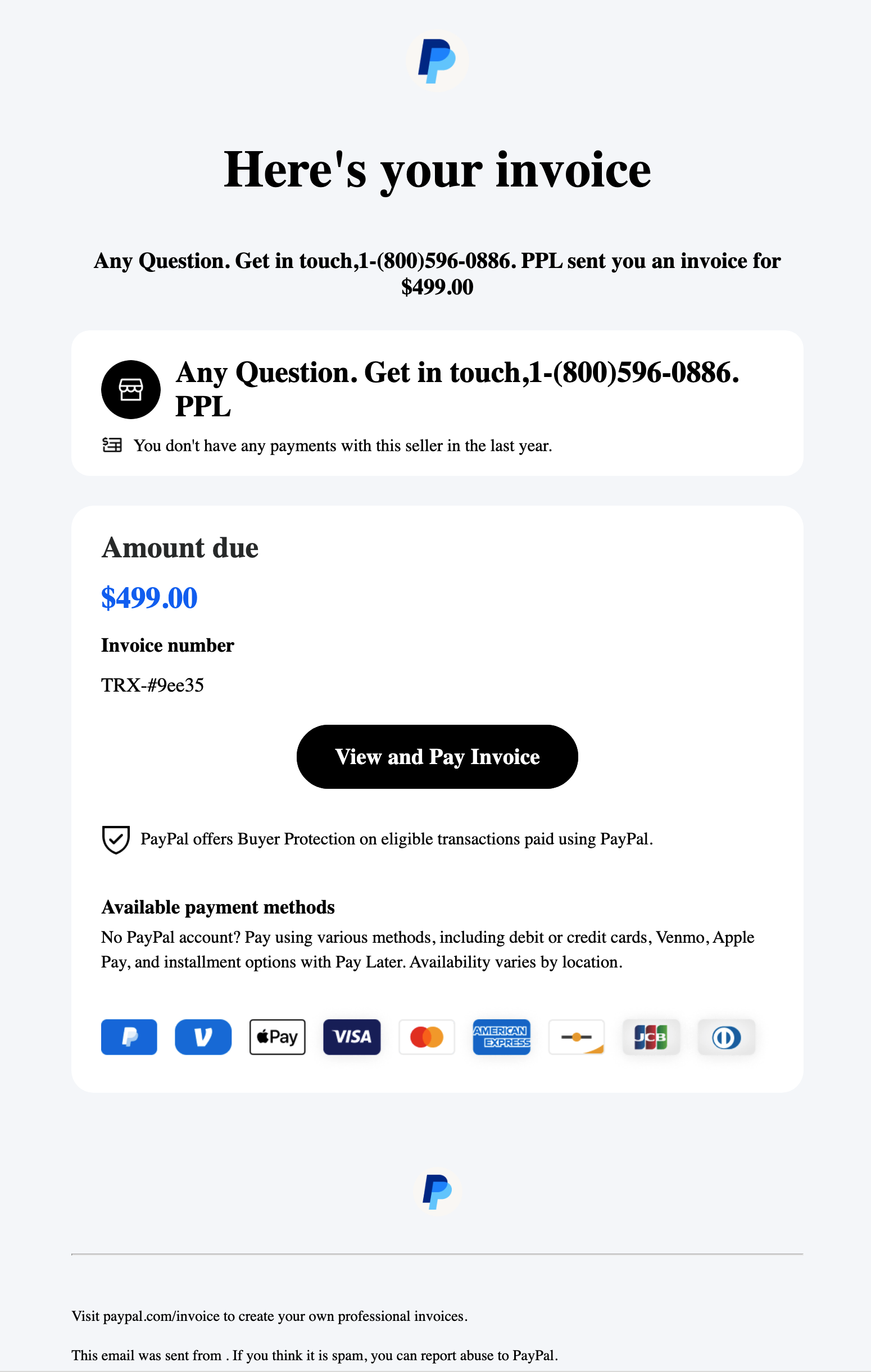
🕵️♂️ We’ve observed a callback phishing campaign abusing legitimate PayPal inv...
The Spamhaus Project @spamhaus@infosec.exchange
🕵️♂️ We’ve observed a callback phishing campaign abusing legitimate PayPal invoice workflows. Here’s how it works⤵️
Attackers create invoices through PayPal, which are then delivered to recipients with instructions to contact the sender. The actual phishing occurs during this follow-up...
To make the campaign scalable and appear more legitimate, invoices are created through PayPal and sent via distribution lists created in Microsoft Outlook to addresses hosted on dedicated (criminal-owned) domains (see comments).
The target addresses act as “exploders” meaning they automatically redistribute incoming messages to large numbers of pre-configured emails.
As a result:
✅All messages are legitimately DKIM-signed by PayPal
✅Authentication is validated
✅Emails are then ARC-sealed by Outlook
For the final recipient, the messages appear fully authenticated and legitimate.
Subjects observed include ⤵️
✉️Invoice from Question ! Get in touch, 8OO_596_O886. PPL (TRX-#1234)
✉️Invoice from Question ! Get in touch, 8OO_596_O886. PPL (TRX-#1234)
✉️Invoice from Any Question. Get in touch,1-(800)596-0886. PPL (TRX-#1ab23)
✉️Invoice from Any Question. Get in touch,1-(800)596-0886. PPL (TRX-#1ab23)
PayPal has been notified and is actively blocking the abuse from generating more invoices. Microsoft has also been informed regarding the Outlook infrastructure involved.